
Sterling silver identification basics
Start with the mark, then confirm material and construction. A 925, sterling, lion passant, or maker stamp should be checked against wear, seams, plating clues, age, and condition before assuming value.
You can identify sterling silver reliably only if you treat the process like a sequence, not a single test. Start with marks, then test materials, then price the object against context. Most mistakes happen when people skip the sequence and jump straight to one signal.
This guide is for people who already know what they have looks valuable and now want a defensible answer. We will not guess at provenance, and we will not pretend a shiny object is collectible-quality silver. We will tell you what to check, what each check proves, and where confidence breaks down.
Your first decision should be this: do I have enough signal to call this sterling, or do I need a specialist before I commit to any transaction-level conclusion? If you need a practical safety check, use the rule below before reading further.
Use this sequence first
- Locate marks in side-light and low-glare conditions.
- Record every symbol before touching anything.
- Read maker, assay, and date clues in that order.
- Cross-check design and condition for internal consistency.
- Pause on uncertainty and request appraisal support.
Step 1: Check marks before value assumptions
The most common error is to treat hallmarks like decoration. They are not decoration. Marks are metadata for your object’s identity. Without reading them, even obvious-looking silver stays “possibly silver.”
What marks usually indicate
- Maker or responsible mark: tells you who stood behind the piece at some stage of production.
- Assay mark: the purity and, in some systems, geography control framework.
- Town/date marks: often narrow production windows.
- Duty symbols and related office marks: add a second control in regions and eras where they apply.
What “925” and “STERLING” usually mean
925 and words like STERLING are practical starting points for purity language. They increase confidence, not close the file. In practice, the strongest conclusions come when mark interpretation aligns with maker style, construction behavior, and condition history.
Some valid older objects lose marks from wear, cleaning, or later alterations. Some non-sterling objects also print convincing symbols. The difference is that marks that are complete, coherent, and category-appropriate are usually stronger than marks that are partial or mismatched.
Step 2: Read marks by category, not by intuition
Flatware, jewelry, and decorative service are handled differently in practice. Treating them as one class causes 80% of mark misreads.
Flatware and tableware
Look at seams, feet, and underside planes that are less handled than the food-facing surfaces. Expect heavier natural wear on use edges but cleaner stamp points around joins. If many pieces in one set share partial or missing marks while others do not, question provenance consistency.
Jewelry and wearable silver
Jewelry uses tiny marks, solders, and hidden seams. You need magnification and angled light to confirm whether symbols were applied at manufacture or added later. Hidden join lines and hinge-style repairs can create false confidence, so pair mark quality with wear behavior.
Ornamental and large forms
Teapots, tankards, and lidded forms hide marks behind hardware and solder lines. Search around lid feet, ring seats, and structural seams before giving up on incomplete markings.
This category-level approach is how we keep “looks right” from becoming “proved.”
What market comparisons should and should not prove
Internal comps are helpful for calibration because they expose what finished, marketable outcomes actually look like. They should shape your expectations, not your final answer. In this lane, that means we use comps to understand typical value bands, then confirm every object against maker, age, and condition.
Internal context for this topic includes broad silver-related lots, including examples from auction outcomes spanning practical silver service and specialist categories. The spread is wide because silver-related lots are heterogeneous. Use this as temperature, not a price promise.
In practice, the same amount of silver purity can perform very differently if the object is complete, unrestored, and attributable. As the internal guidance has shown repeatedly, completeness and condition can beat metal content on outcome quality when buyers decide quickly.
Free instant estimate
Not sure if your item is worth appraising? Let us take a look.
Upload a photo, tell us what you know, and get a free first read. If a full appraisal makes sense, we will say so.
Free. No card needed. Takes about two minutes.
Step 3: Separate material types before you estimate value
Purity alone is not a complete identity test. This is where most mislabels come from. If you are reading this guide because you want to avoid mistakes, separate material behavior from mark confidence.
- Solid sterling: stronger internal consistency and longer-term market recognition in the right categories.
- Plated silver: can mimic sterling marks at a glance and can look excellent in photos.
- Silver-filled / mixed alloys: useful in function and appearance, but they usually behave differently in resale channels.
- Reworked objects: excellent polish can hide structural inconsistency and should not increase confidence by itself.
Practical reading rule: if material behavior contradicts mark behavior, escalate to specialist review before you quote any value. A cleanly marked but materially inconsistent piece needs more evidence.
Age clues that move or break the story
Age is often misused as a shortcut, when it should be one piece in a triangulation model.
- Design cues
- Profile shape, border language, and tooling patterns should match the era implied by marks, not just the user’s taste.
- Wear profile
- Uniform, age-consistent wear supports a single history; fresh localized abrasions are often post-production interventions.
- Repairs and joins
- Solder seams and replacement sections can be honest and still valuable, but they usually shift pricing expectations.
- Surface tone
- Natural patina differs from artificial re-finish in edge depth, undercut behavior, and old wear lines.
Where this lane hurts the most is when people infer age directly from appearance and ignore inconsistency around marks and construction.
How condition and completeness affect practical outcome
This is the part most people skip, and it is where your decision can be off by a lot.
Condition ladder you can apply quickly
Tier 1: Cleanly used. Light handling wear and minor toning with intact structure. Usually manageable.
Tier 2: Altered or reworked. Solder lines, altered edges, or patching affect both buyer trust and resale depth.
Tier 3: Missing structure. Missing components, uncertain joins, or major repairs can change how buyers rank the lot, even when marks are clear.
In short: form, maker, age, and condition are usually stronger than purity percentage once you are past the first verification pass.
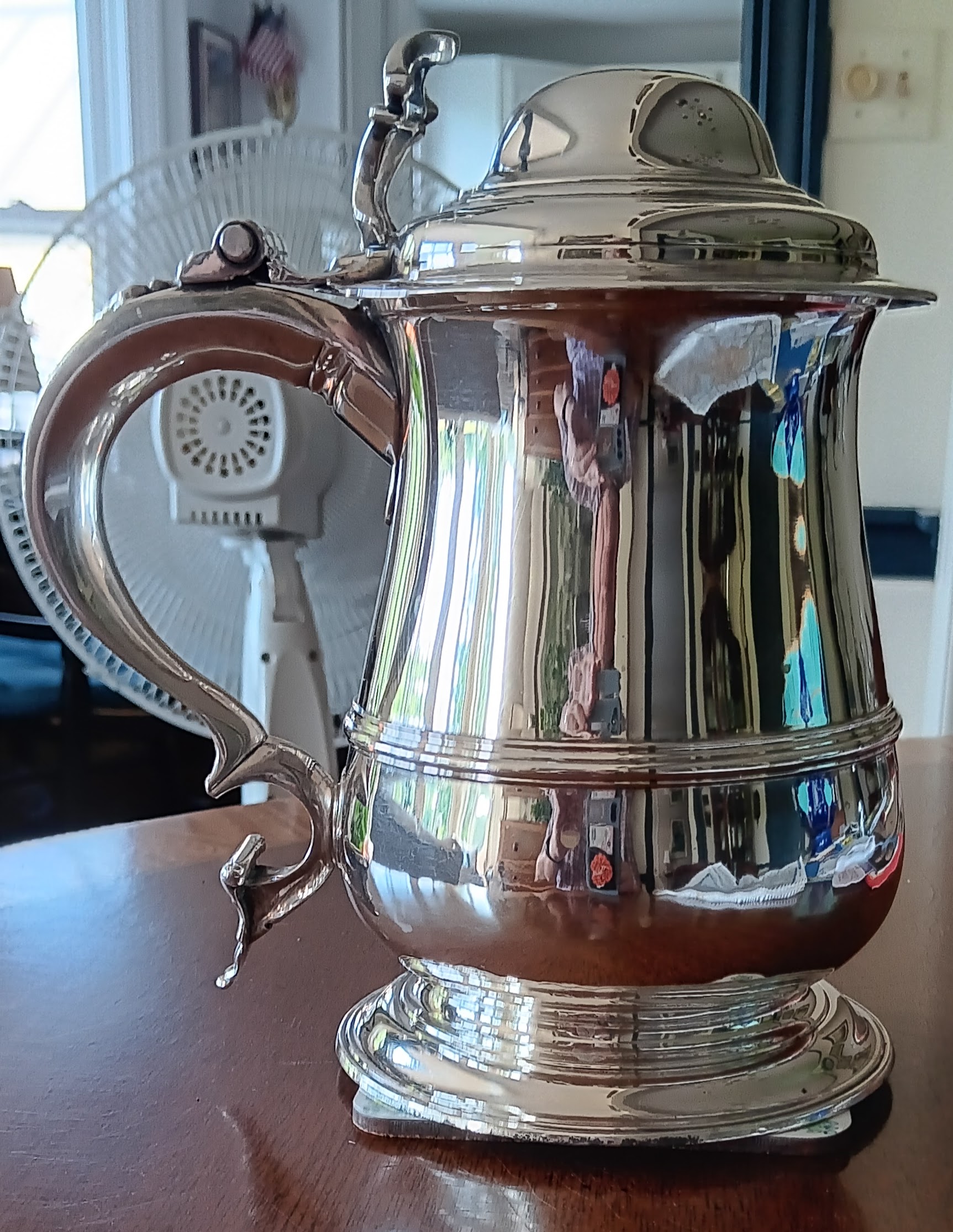
Case study reference: 1749 London sterling lidded tankard
We use this public case as a reminder of how to apply the process instead of as a fixed valuation quote. The object is listed as a sterling tankard attributed to Henry Bourne with hallmark and date-letter context and light age wear in photos.
The case is useful for sequencing: marks, form, and condition are considered together. It also shows how a real item can still need a final specialist read when one layer feels uncertain.
Public example: 1749 London sterling silver lidded tankard.
Common mistakes people still make
- Stopping after “it looks old.” Age impression is useful, not sufficient.
- Treating every “925” print as final proof. Missing context means you should escalate, not over-commit.
- Ignoring missing parts before resale calls. Incomplete sets or repaired joins often carry hidden cost.
- Confusing complete silverware with complete evidence. One unverified item does not validate a full lot.
- Using one auction lot as a guaranteed price. Comps are markets, not outcomes for one specific object.
- Applying the same check to all categories. Jewelry, tableware, and decorative forms need different mark logic.
- Assuming monograms are always value-positive. Monograms can help with attribution, but condition can still dominate if damaged heavily.
FAQ
Can I trust a 925 mark?
It is a strong lead when the mark is complete and coherent with maker and category context. If your item is unclear, continue with specialist confirmation before final trust.
Can I identify silver from photos only?
Yes, for a first-pass triage and obvious rejects. For pricing decisions, use close macro detail, edge photos, and marks from multiple angles. If those are missing, classification confidence is lower.
What if my item has no marks?
Then material behavior, workmanship, and condition become your primary evidence. You are not blocked—you are shifted into a higher uncertainty path that still reaches a reliable identity through specialist workflow.
When should I request an appraisal instead of self-checking?
Request an appraisal when you need action risk reduction: listing, insurance, donation documentation, or disputes between buyer and seller assumptions.
Do monograms, dents, or repairs always hurt value?
Not always, but they can. The impact depends on repair quality, location, rarity, and whether core hallmarks remain legible and coherent.
Note: We couldn’t find enough auction records that directly match How to Identify Sterling Silver: Marks, Materials and Age Clues to publish a defensible price table. If you are valuing a specific item, include its maker, model, material, photos, and condition so the search can be narrowed.
What similar items actually sold for
The current auction search does not contain at least three clean, directly matched sales for How to Identify Sterling Silver: Marks, Materials and Age Clues yet. If you’re valuing a specific item, use the free estimate flow so the search can be narrowed by maker, material, photos, and condition.
| Image | Description | Auction house | Date | Lot | Reported price realized |
|---|---|---|---|---|---|
| No relevant auction comps found for this topic right now. | |||||
Disclosure: prices are shown as reported by auction houses and are provided for appraisal context. Learn more in our editorial policy.
People also ask
- How to identify sterling silver on old flatware and tea sets
- Does missing 925 mean an item is not sterling
- How to read sterling silver hallmarks at home
- What does a London maker mark usually indicate
- How to tell plated silver from sterling in photos
- How repaired silver affects appraisal outcomes
- What age clues matter for silver tea service
- How to check if monogramed silver is authentic