
Why these checks are this important
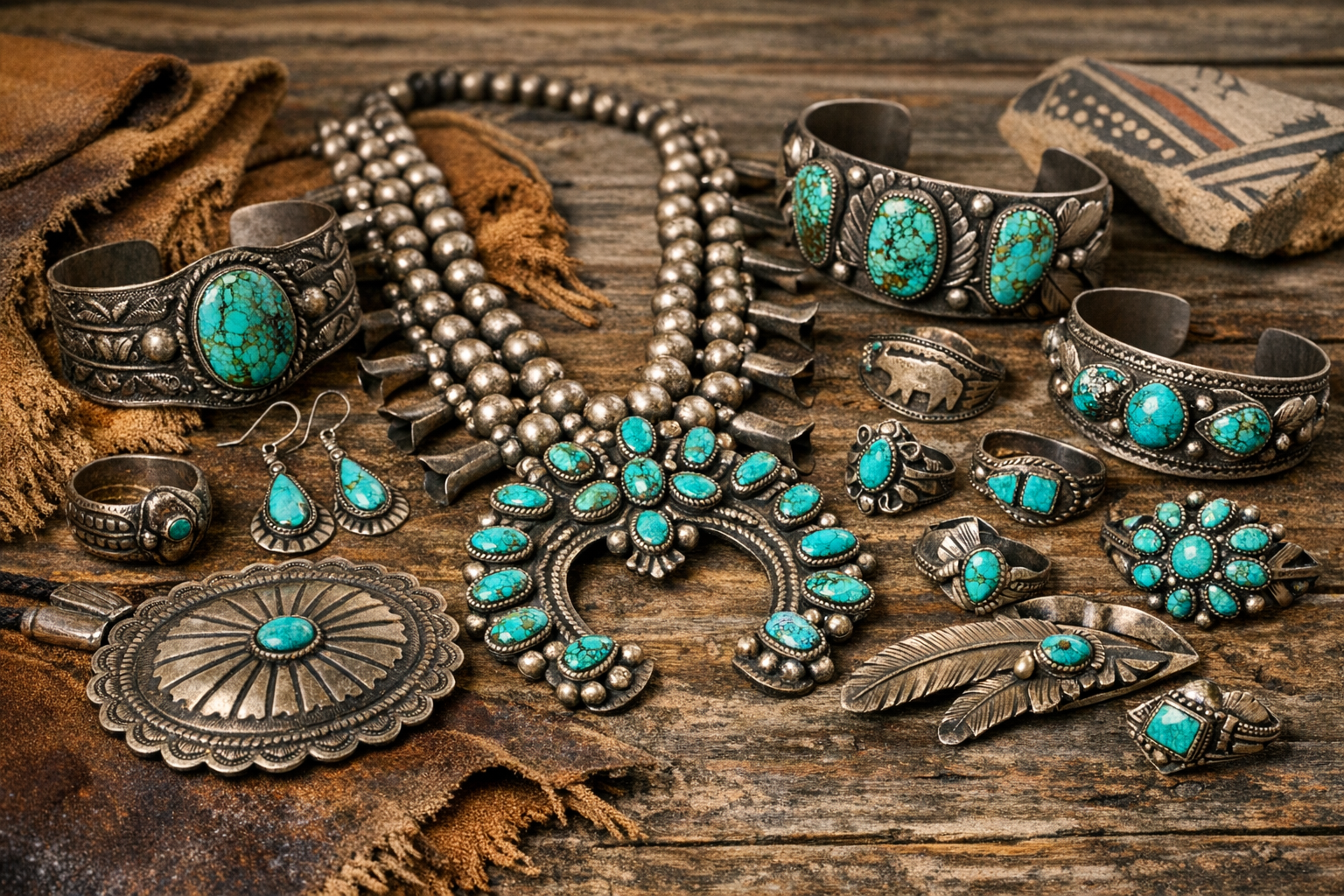
A bracelet, ring, or pendant can look exactly like traditional Native American work at first glance. The biggest risk is that you trust the story instead of the object. Two pieces with similar stones can differ by 4x in market behavior when materials, technique, or maker lineage are different.
This guide is built for the reader who wants a strong first-pass classification: is this likely Native American jewelry, where might it have been made, and which signals should trigger a pro review. You’ll see what to inspect, what to doubt, and which mistakes destroy pricing clarity. Think of it as an evidence checklist before you commit to a value claim.
If this is a collection with more than one item, score each one individually; one genuine hallmark does not authenticate an entire set.
Flip it over: what marks and signatures can actually tell you
In identification-first topics, marks are only useful when read as a system, not as a single symbol. Start by checking these first.
Mark placement and consistency
- Look at edges, inner clasps, and less visible inner surfaces where a maker mark or metal stamp is usually placed.
- Verify that stamps share the same aging style as the rest of the object, including edge wear and oxidation tone.
- Check whether the engraving line quality is sharp and uniform or fuzzy and shallow.
- Confirm whether markings appear pre-plated, post-finished, or recently engraved.
Modern cast marks can be perfectly clean and still be authentic to a workshop, but they should match the object's broader manufacturing style. If a mark looks too newly cut compared with 80-year-old surfaces, treat that as a flag requiring deeper proof rather than a final answer.
Maker marks versus style labels
Some objects have maker signatures; many have workshop marks; some have commercial marks that are not artist-level attributions. The strongest identifier is usually consistency across three layers: mark language, construction method, and material behavior. A single good symbol does not override weak evidence elsewhere.
- High-confidence signal: matching mark style plus matching joining method and metal treatment.
- Moderate signal: mark present, but location/edge wear does not match the broader finish.
- Low-confidence signal: clear mark is visible only on one small part and no other consistency follows.
Check materials before stories: what the metal and stones are telling you
For jewelry identification, materials are often more reliable than story claims. Ask your piece three base questions: what are the base metals, what stone is set in it, and how does the entire build respond to wear?
Base metal signals
- Sterling silver: Look for smooth surface transitions, controlled solder seams, and oxidation that follows wear age rather than random patching.
- Gold alloys: Confirm whether color shifts and polish style align with period technique.
- Mixed metals: Mixed-tone pieces can be original, but abrupt color change at joints can signal replacement parts.
- Claw or setting style: Repetitive modern machine marks can indicate later repair or recent reassembly.
In our internal comps set, similar mixed-metal pieces can sit in a broad price band depending on condition clarity and maker evidence. This is why materials must be interpreted with process and workmanship, not as isolated clues.
Stone and color behavior
Stone patterning changes are often where buyers get misled. A lot of look-alikes use synthetic finishes that mimic age but do not show natural inclusions and depth in the same way.
- Compare color consistency across the same stone type on the same object.
- Check whether the polish is surface-only or integrated into metal channels.
- Inspect micro-chipping around settings for old versus fresh edges.
- Photograph natural light and shadow details before trusting close-up images.
Read age clues without guessing years
Age should be inferred, not guessed. The strongest age clues come from wear patterns and repair history, not from one “antique look” feature.
Wear signatures that usually age well
- Soft, continuous tonal transitions in high-contact areas.
- Minor edge rounding where metal has met skin over many years.
- Small, plausible setting stress lines that match repeated handling.
- Older assembly marks consistent with known solder techniques of the piece’s claimed period.
Age clues that often overstate value
- Uniformly “aged” tone from deliberate chemical treatment.
- Brand-new internal surfaces paired with heavily worn exteriors.
- Replacement stones with modern facets on a historically styled frame.
- Unusual patina concentrated only on one area while the rest looks freshly worn.
Age is only one input. A beautiful, well-preserved modern reproduction can command demand for craft, but the buyer often pays less than for a naturally aged piece of similar design with stronger provenance evidence.
Maker pattern and workshop cues: where identity gets stronger
Maker-level identification is strongest when multiple stylistic and technical anchors line up:
- Symmetry rhythm: repeated motifs should flow through the object, not look pasted in.
- Tool marks and finishing passes: oldwork often shows purposeful repetition that modern casting can replicate, but usually with different surface variance.
- Repair philosophy: older pieces commonly show period-consistent repairs in the same language as the original build.
If you do not have provenance paperwork, treat the object as “unresolved” instead of forcing a conclusion. An unresolved conclusion is not failure; it is disciplined identification.
Common mistakes people make when identifying Native American jewelry
Most mistakes happen in phase two, after the first “this is probably real” reaction.
Most repeated errors
- Conflating style with authenticity. Traditional motifs are common, but style alone cannot certify origin.
- Overweighting a single hallmark. One symbol can be copied; complete context is harder to fake.
- Ignoring material mismatch. Stone mounting style and metal behavior need to align.
- Letting auction photos replace direct inspection. Auction photos help for range, not authentication.
- Assuming older always means higher value. Provenance and condition continuity are often more valuable.
The safer practice: if two signals disagree, pause and reduce certainty. A lower-confidence classification is cleaner than a confident guess with weak evidence.
How auction comparables usually shape value here
Comparable sales matter because they show how the market rewards material and condition, but they are only meaningful when read as a range, not a promised outcome for your one piece.
In our internal comps pull, broadly comparable silver and fine-metal pieces tied to similar categories have appeared anywhere from around $340 to $3,600. That spread is wide because condition, maker evidence, and construction quality change outcomes dramatically.
What comps can and cannot do: They can calibrate expectation and show market bands, but they are not a substitute for authentication. The same motif can perform very differently when hallmark quality and repair history differ.
When comps are useful, the best read is this: if your piece has clear maker context and stable construction, higher-quality ranges become plausible. If markings are unclear and repairs are mixed, value confidence drops even when styling is strong.
Free instant estimate
Not sure if your item is worth appraising? Let us take a look.
Upload a photo, tell us what you know, and get a free first read. If a full appraisal makes sense, we will say so.
Free. No card needed. Takes about two minutes.
Think your piece might be worth a full appraisal?
After review, if marks and construction look strong, the next step is a full specialist read and valuation package.
Upload photos and get a free first read.
If this item merits it, we will say what to document next and which evidence to add.
Upload a photo and see what similar items have sold forDecision criteria: when to keep testing and when to send it in
Use this practical rule:
- Confident to proceed: coherent marks + consistent material behavior + clear age progression.
- Needs manual review: any one strong signal is missing or contradictory, especially marks versus wear profile.
- Send to specialist: clear mismatch across multiple signals, unusual repair signature, or uncertain provenance details.
This keeps the process sane. You can still appreciate the object without over-claiming identity. The cleaner your decision path, the cleaner the outcome.
Need the process done today with stronger confidence? Free photo-based first reads are fastest for high-risk decisions.


