
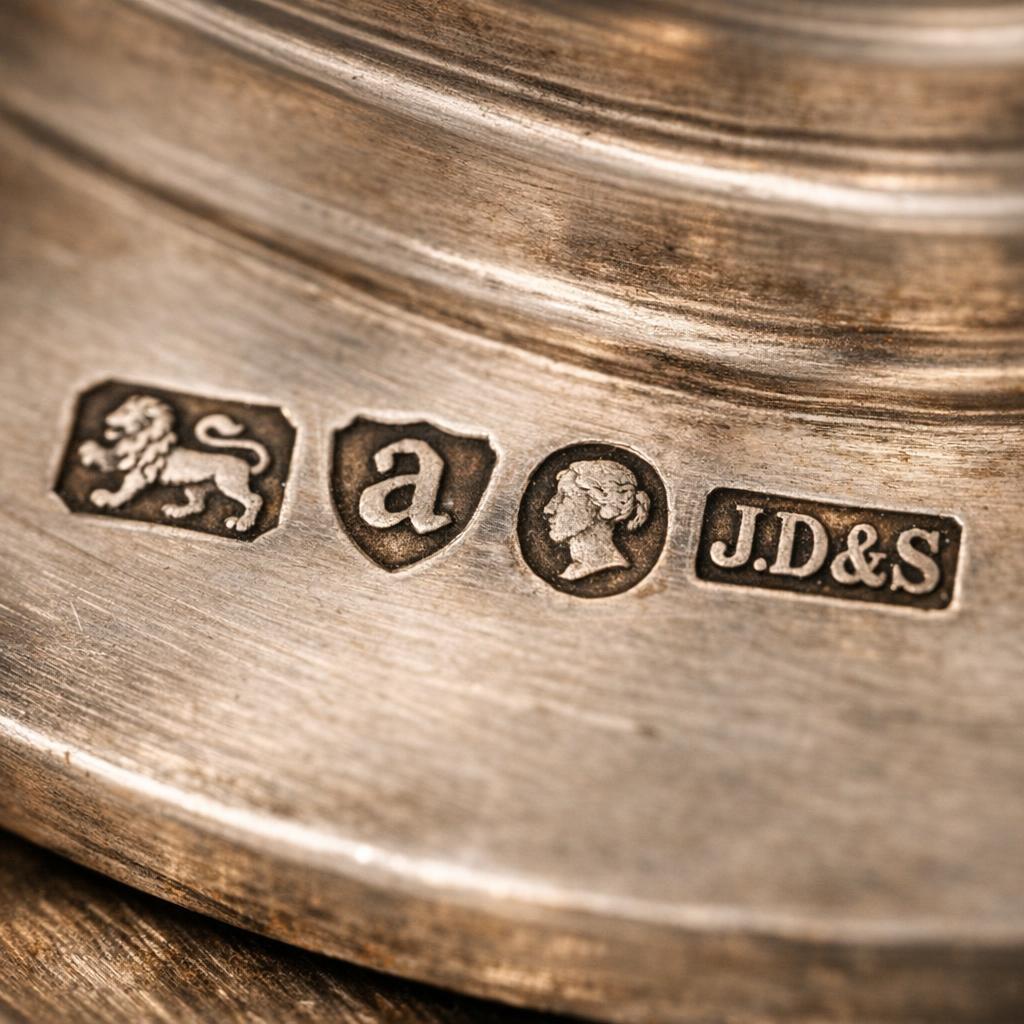
Estate jewelry identification basics
Treat marks as evidence, not proof. Photograph every stamp, then compare metal content, construction, clasp style, stone setting, wear, repairs, and provenance before drawing conclusions about age or value.
Quick 90-second ID triage
Start with a short evidence pass before your first assumption. Most estate jewelry decisions are won or lost in these eight checks:
- Capture both sides: top, clasp/back, hinge, inside cavities, solder lines, and any hidden marks.
- Record material feel: coolness, weight, and solder behavior often separate solid metals from plated look-alikes.
- List all marks: even partial, faint, or worn marks are useful when cross-referenced.
- Look for tool signatures: hand-tooling, file marks, and finishing style reveal manufacturing era.
- Check setting style: antique prong work and bezel styles age very differently from mass-produced modern settings.
- Identify stones visually: cut geometry and wear pattern usually expose replacement behavior.
- Look for modern interventions: repaired prongs, fresh solder, aggressive polish, or modern threads suggest restamping or heavy restoration.
- Pause before buying in: if still unclear, send clear photos before using the piece for valuation decisions.
That last step is where most people go wrong. The strongest appraisal starts with clear evidence, not a single guess.
How to read estate jewelry marks under pressure
Marks are the highest-value clues, but only when interpreted correctly:
- Maker’s mark: should match known engraver logos, initials, or punches for the claimed region and likely era.
- Hallmark symbols: purity marks for silver/gold are often legal standards in many markets, but counterfeit marks exist.
- Assay office and country marks: often indicate age and import regime constraints.
- Clues around the mark: fonts, letter spacing, edge style, and strike depth matter more than the symbol itself.
If a piece has no readable mark, treat it as a research problem, not a low-value problem. Unmarked pieces are not automatically modern — but they are incomplete evidence.
What makes marks credible?
Evidence is strongest when marks align with multiple layers:
- Mark era aligns with expected hallmark style.
- Material quality supports the same production period.
- Construction details support wear and repair pattern.
- Provenance context does not contradict the marks.
If two layers disagree, hold judgment and collect more photos.
Materials are your age signature, not just your price clue
Material reading is often overlooked because buyers look first for beauty. For identification, it is more important.
Silver and gold: what to inspect
- Sterling silver normally shows intentional oxidation and micro-abrasion in the same regions that bear wear. Uniform sheen across an item can indicate modern polishing.
- Gold pieces with no hallmark but old wear patterns can still be high-value if manufacturing style is period-correct; still, no mark lowers confidence.
- Layering and solder around prong joints reveal whether repairs are historically sympathetic or recent.
Gemstones and metal interfaces
For identification, the mount tells you where provenance lives:
- Old bead-and-bond prong tension in vintage work is often uneven and more hand-filed.
- Machine-set modern stones often have near-identical burrs and regular alignment from automated tooling.
- Repolished bezels can hide prong height and seat depth clues.
Do not confuse clear, color-stable stones with age certainty. A lab-grown topaz can look “old” in photos but fail on microscopic cut structure and setting context.
Age clues beyond marks
Use five age clues that survive even when marks are partial:
Wear pattern and edge behavior
Original wear is irregular. Refinished antiques often show polished “flat” edges where micro-scars should be. Compare:
- Hook or hinge movement lines where one side shows normal metal compression.
- Edge burr consistency in prongs that should vary by age if hand-finished.
- Inside surfaces: polished interiors often betray modern cleaning.
Fasteners, hinges, and structural clues
- Modern threaded inserts and uniform screws usually indicate 20th/21st-century service work.
- Antique hinge geometry often includes tool-lift irregularities that reflect handcrafted setting methods.
- Backplate seams and solder seams should match the piece’s reported era; “too neat” seams can mean restoration.
How market context changes interpretation
The same object can shift from “likely replica” to “premium heirloom” once you match evidence quality and market context. Use your comps and sales references as supporting context, not as a primary identification source.
For example, when two near-identical rings show the same clasp design and setting pattern, a documented sales trend can help you narrow value bands while you continue to validate mark lineage and restoration history.
Note: We couldn’t find enough auction records that directly match How to Identify Estate Jewelry: Marks, Materials and Age Clues to publish a defensible price table. If you are valuing a specific item, include its maker, model, material, photos, and condition so the search can be narrowed.
What similar items actually sold for
The current auction search does not contain at least three clean, directly matched sales for How to Identify Estate Jewelry: Marks, Materials and Age Clues yet. If you’re valuing a specific item, use the free estimate flow so the search can be narrowed by maker, material, photos, and condition.
| Image | Description | Auction house | Date | Lot | Reported price realized |
|---|---|---|---|---|---|
| No relevant auction comps found for this topic right now. | |||||
Disclosure: prices are shown as reported by auction houses and are provided for appraisal context. Learn more in our editorial policy.
Free instant estimate
Not sure if your item is worth appraising? Let us take a look.
Upload a photo, tell us what you know, and get a free first read. If a full appraisal makes sense, we will say so.
Free. No card needed. Takes about two minutes.
Common mistakes that ruin identification quality
Single-factor diagnosis
Choosing one clue — one mark, one stone, one story — is usually wrong. Good ID is a consistency check across marks, materials, and wear behavior.
Assuming uniform shine means high quality
Uniform shine often signals a recent polish. High-quality antique pieces usually show variation in tonality where wear naturally concentrates.
Confusing restoration for originality
Fine restoration can protect a piece but can also erase identification evidence. If restoration is heavy, treat marks and provenance as provisional until specialist confirmation.
Weak photography
Most wrong calls happen on compressed photos. For reliable review: shoot in white light, include a ruler reference, and capture mark locations at close angle.
When to pause and ask a specialist
Escalate when:
- Multiple marks disagree and one may be post-production.
- Valuable stones are present without provenance.
- You plan insurance, estate transfer, or tax-sensitive donation.
- The item may be family-owned and sentimentally or financially sensitive.
At that point, your best action is documented specialist review with photo set, close-mark shots, and any receipts or photos from the original source.
Search variations collectors ask
Readers often ask these questions before sending an item to a specialist:
- How to identify estate jewelry without clear hallmarks?
- What makes a jewelry hallmark trustworthy?
- How to tell old solder from restoration on a ring?
- How do I check if an estate silver chain is real?
- What marks indicate modern refinishing or repolish?
- Why does an item have one old mark and one modern mark?
- How to identify a piece with no jeweler signature?
- What are common estate jewelry red flags?
- Can hallmarks be forged on costume jewelry?
- When should I stop DIY identifying jewelry?
The guide above addresses the highest-frequency causes of wrong identifications: weak evidence and over-reliance on one clue.
References
- National gold and silver hallmark references from regional assay records and recognized trade sources.
- Current and historical silver mark databases used in internal valuation workflows.
- Appraisily internal auction-comps database for comparable context.
- Editorial policy and valuation standards.
Need estate jewelry identified before you sell, insure, or divide it?
Upload photos of the marks, front, back, clasp, stones, and any paperwork. We can help connect the clues to a defensible appraisal path.
- Focused review of hallmarks, signatures, and construction details
- Help separating period clues from later repairs or mixed components
- Clear recommendation for resale, insurance, donation, or formal appraisal
Secure intake · No obligation · Specialist review path