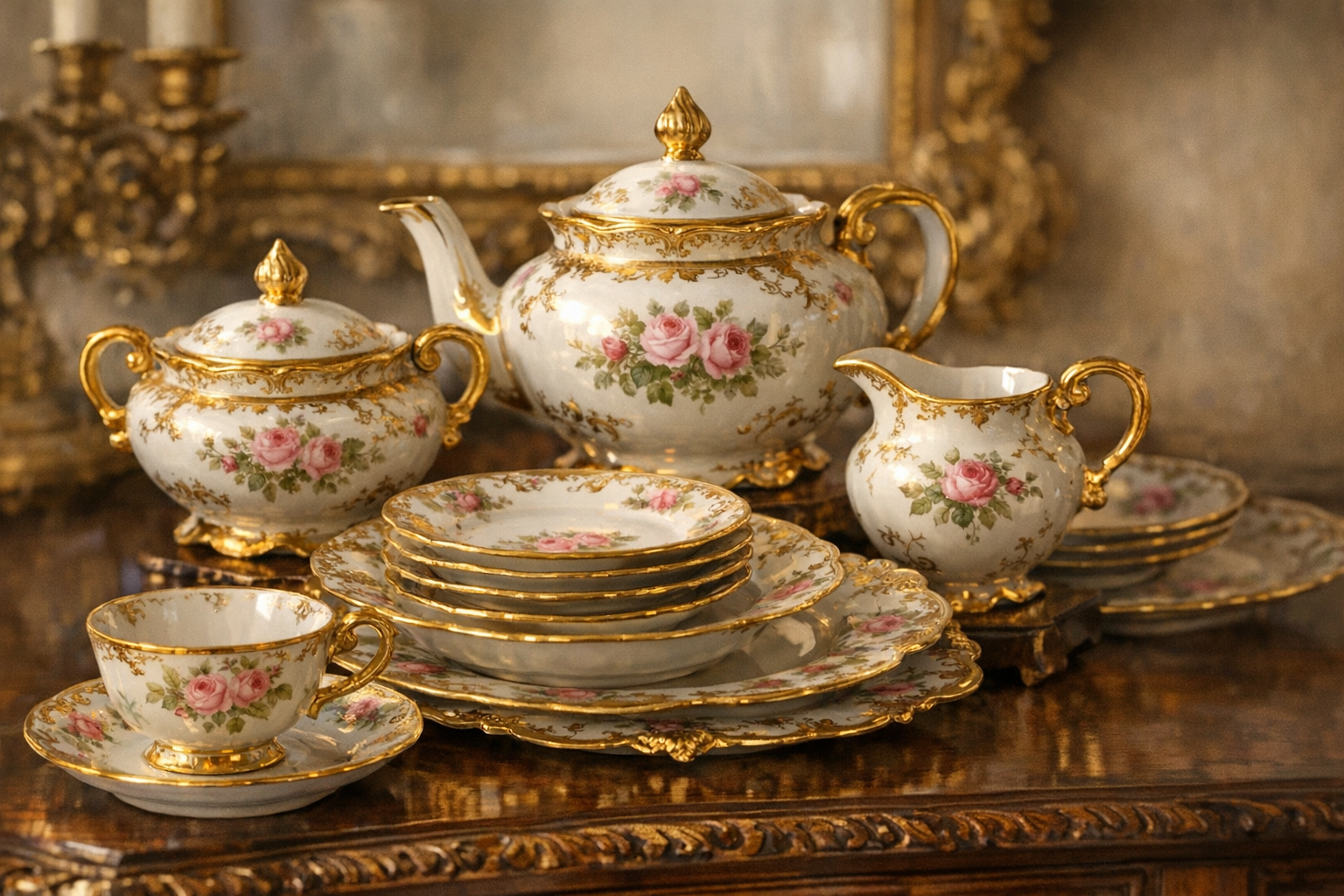
China Value Guide: value basics
China value depends on maker, pattern, age, porcelain or bone china type, place-setting completeness, serving pieces, backstamp date range, condition, replacement demand, and current resale market.
Inheriting Grandmother’s fine china or discovering a beautiful set at an estate sale often leads to the question: “How much is my china worth?” Whether you’re curious about value for insurance purposes, considering selling, or simply want to understand what you own, determining the value of china requires careful assessment of several key factors.
In this comprehensive guide, we’ll walk you through the process of identifying, researching, and valuing your china collection. From recognizing valuable makers’ marks to understanding how condition impacts price, we’ll provide expert insights to help you determine what your china is truly worth in today’s market.
Why China Values Vary So Dramatically
The value of china depends on multiple factors that work together to determine its worth in the collector’s market. Understanding these elements is crucial for accurate valuation:
Digital vs. Traditional Valuation Methods
While traditional appraisal by experts remains the gold standard for valuable china, technology has created new options:
- Identification Apps: Some apps allow you to photograph items for preliminary identification
- Online Valuation Services: Virtual appraisals based on submitted photos
- Social Media Groups: Collector communities can help identify patterns and estimate values
- Video Appraisals: Remote expert consultations via video call
For items potentially worth over $500, an in-person professional appraisal is strongly recommended despite the additional cost.
Where to Sell Your China
Selling Options Comparison
Different sales venues offer varying advantages depending on your china’s value and your timeline:
China Selling Options
Comparison of selling venues for china
| Category | Price | Notes | |
|---|---|---|---|
| Rare Chinese Imperial Famille Rose Porcelain Bowl | $9.5 million | March 2021 | Sotheby's |
| Meissen Porcelain Figure Group "The Indiscreet Harlequin" | $197,000 | January 2023 | Christie's |
| Royal Copenhagen Flora Danica Complete Service for 12 | $75,000 | November 2022 | Bonhams |
| Wedgwood Fairyland Lustre Vase | $32,500 | May 2023 | Heritage Auctions |
</tbody> </table>
For valuable china, consider getting multiple offers before selling to ensure you receive fair market value.
Professional Appraisal Options
Types of Professional Appraisals
Different appraisal formats serve different needs:
Written Appraisal: Formal document with detailed descriptions and valuations
- Best for insurance, estate planning, or high-value items
- Typically costs $75-$300 per hour
Verbal Consultation: Informal assessment without documentation
- Good for preliminary value assessment
- Usually $50-$150 per session
Online Appraisal: Remote assessment based on photographs
- Convenient but less precise than in-person evaluation
- Costs range from $10-$100 depending on detail level
Auction House Evaluation: Free assessments to determine if they’ll accept items for sale
- No cost but focused on auction potential rather than comprehensive valuation
When seeking professional appraisal, choose an appraiser with specific expertise in ceramics and porcelain for the most accurate assessment.
External Resources for China Identification & Valuation
Replacements, Ltd. Pattern Identification
Search database of over 425,000 china, crystal, and silver patterns for identification and retail price information.
Kovels' Online Price Guide
Subscription-based access to auction prices, marks identification, and valuation guides for antique china.
International Society of Appraisers
Directory to find certified professional appraisers specializing in fine china and porcelain.
LiveAuctioneers Past Auction Results
Search past auction results to find comparable sales for similar china pieces.
The Potteriesauctions Royal Albert China Guide
Detailed guide to identifying and valuing Royal Albert china patterns and sets.
Vintage and Antiques China Valuation Service
Remote professional valuation service specializing in antique and vintage china patterns.
iGuide Fine China Price Guide
Online price guide with updated values for various china patterns and makers.
Shop Legacies China Identification Guide
Comprehensive guide to identifying china makers, patterns, and determining values.
Preserving Value in Your China Collection
Storage and Handling Best Practices
- Storage Environment: Store in climate-controlled spaces away from extreme temperatures
- Protection: Use felt or paper separators between stacked plates
- Display Safely: Secure display cabinets with plate stands for proper support
- Handling Techniques: Always use both hands and avoid stacking without protection
- Cleaning Methods: Hand wash with mild soap, avoid harsh chemicals and dishwashers
- Documentation: Keep records of provenance, purchases, and any professional appraisals
Maintaining documentation of your china’s history, including receipts, certificates, and family provenance, can significantly enhance its value to collectors.
Common Questions About China Values
How can I get my china valued?
-
Self-research: Identify your pattern using the maker’s mark and research comparable sales online through sites like eBay, Etsy, and Replacements.com.
-
Online valuation services: Submit photos to specialized services that offer remote appraisals, typically costing $10-$100.
-
Local antique dealers: Bring your china to knowledgeable dealers who may offer free assessments if you’re considering selling.
-
Professional appraiser: For valuable pieces, hire a certified appraiser specializing in ceramics and porcelain. This typically costs $75-$300 per hour but provides the most accurate and official valuation.
-
Auction house evaluation: Major auction houses offer free assessments for items they might accept for sale.
How can I tell how old my china is?
-
Maker’s mark/backstamp: Manufacturers changed their marks over time. Research the specific format, color, and wording of your piece’s mark to narrow down production dates.
-
Country markings: Items made before 1891 often lack country of origin. Pieces marked simply "England" typically date 1891-1914, while "Made in England" indicates post-1914 production.
-
Pattern registration numbers: Some British pieces have registry numbers that correspond to specific dates.
-
Materials and production techniques: Hand-painted details versus decals, glaze characteristics, and porcelain composition can indicate time periods.
-
Style and design elements: Certain decorative styles were popular in specific eras (e.g., Art Deco in the 1920s-30s).
Is gold rimmed china worth anything?
-
Manufacturer: Gold-rimmed pieces from prestigious makers like Lenox, Wedgwood, or Limoges are generally more valuable.
-
Type of gold application:
- 24K gold or "coin gold" rims have higher intrinsic value
- Acid gold (bright, reflective) is typically more valuable than gold luster (more matte appearance)
- Hand-applied gold typically commands higher prices than machine-applied gilt
-
Condition of the gilding: Gold rims that show significant wear, fading, or rubbing are worth substantially less. Gold that maintains its brightness and coverage is more desirable.
-
Age: Older pieces (pre-1940) with gold rims often have higher quality gilding and better craftsmanship.
-
Pattern popularity: Some gold-rimmed patterns remain in high demand regardless of age.
What is the most valuable china pattern?
-
Royal Copenhagen Flora Danica: Handpainted botanical pattern introduced in 1790. Individual dinner plates can sell for $1,000-$2,500, with complete services fetching $50,000-$100,000+.
-
Meissen’s Ming Dragon: Antique examples of this pattern regularly sell for thousands per piece.
-
Wedgwood Fairyland Lustre: Created by Daisy Makeig-Jones in the 1920s, these pieces can sell for $5,000-$30,000 depending on form and condition.
-
Herend Rothschild Bird: Hand-painted Hungarian porcelain featuring detailed birds and butterflies, with dinner plates selling for $300-$800 each.
-
Mottahedeh Sacred Bird and Butterfly: Reproduction of a Chinese export pattern that maintains strong value at $200-$500 per dinner plate.
Is there an app to identify china patterns and value?
-
Google Lens: Free visual search tool that can identify some patterns by photo.
-
Replacements.com app: Their mobile app lets you search their extensive database and submit photos for pattern identification by experts.
-
What’s It Worth: App that connects users with professional appraisers for paid valuations.
-
Worthpoint: Subscription-based service with a mobile app that provides access to millions of sold items for comparison.
-
iGuide: Online price guide with a searchable database of china patterns and values.
While these tools can be helpful for initial identification, they have limitations. Pattern recognition technology isn’t perfect for detailed porcelain designs, and automated valuations don’t account for subtle condition issues or market fluctuations.
For valuable or rare pieces, these apps should be considered starting points rather than definitive resources. Professional assessment remains the most reliable method for accurate identification and valuation of fine china.How do I sell my antique china set?
-
For valuable sets ($1,000+):
- Specialty antique dealers who focus on porcelain
- Auction houses (consignment with 20-50% commission)
- High-end consignment shops
-
For mid-range sets ($300-$1,000):
- Online marketplaces like eBay or Etsy
- Replacement services like Replacements.com
- Local estate sale companies
-
For common patterns (under $300):
- Facebook Marketplace or Craigslist
- Local consignment shops
- Yard sales or flea markets
When selling online, proper packing is critical. Use double-box methods with plenty of bubble wrap and packing material between each piece. Insurance is strongly recommended.
To maximize your sale price:
- Clean items thoroughly but gently
- Provide complete pattern and maker information
- Include measurements of key pieces
- Highlight any rare serving pieces
- Be transparent about any damage or condition issues
- Include provenance information if available
Conclusion
Determining “how much is my china worth” involves careful assessment of multiple factors including maker, age, condition, pattern, and current market demand. While some pieces may hold primarily sentimental value, others could be worth significant sums to collectors.
For everyday china sets, condition and completeness typically matter more than age, while for rare antique pieces, even damaged items can command impressive prices. The most accurate valuation comes from thorough research, pattern identification, and realistic assessment of condition.
Whether you’re planning to sell, insure, or simply understand your inheritance better, taking time to properly research your china’s history and value can be both financially rewarding and personally enriching. For valuable or rare sets, consulting with a professional appraiser provides the most reliable valuation and can reveal fascinating details about your china’s history and significance.
Remember that market values fluctuate over time as collecting trends change, so periodic reassessment of valuable pieces is recommended, particularly for insurance purposes.
What similar items actually sold for
To help ground this guide in real market activity, here are recent example auction comps from Appraisily’s internal database. These matched sales are market context only, not an object estimate or identification, and they do not guarantee a price for your specific porcelain dinner service.
Shown USD range: USD 175-USD 3,750. Median of these 9 USD examples: USD 400.
| Comparable | What sold | Auction house | Date | Lot | Source-reported amount |
|---|---|---|---|---|---|
 |
Lenox Porcelain Dinner ServiceSource blocked; provenance matched | Capo Auction | 2016-03-26 | 542 | USD 300 (buyer’s-premium treatment unknown) |
 |
A Versace Assembled Porcelain Dinner ServiceSource blocked; provenance matched | Freeman’s | 2025-12-03 | 20 | USD 500 (buyer’s-premium treatment unknown) |
 |
A Puiforcat Chelsea Porcelain Dinner ServiceSource blocked; provenance matched | Hindman | 2023-03-16 | 1064 | USD 3,750 (buyer’s-premium treatment unknown) |
 |
MOTTAHEDEH PORCELAIN DINNER SERVICESource blocked; provenance matched | Abell Auction | 2015-02-08 | 35 | USD 1,300 (buyer’s-premium treatment unknown) |
 |
(29) LIMOGES PARCEL GILT PORCELAIN DINNER SERVICESource blocked; provenance matched | Austin Auction Gallery | 2021-07-25 | 1407 | USD 175 (buyer’s-premium treatment unknown) |
 |
Royal Doulton Pomeroy Porcelain Dinner Service, 65Source blocked; provenance matched | Auctions at Showplace | 2018-08-05 | 173 | USD 250 (buyer’s-premium treatment unknown) |
 |
Wedgwood Part Porcelain Dinner Service,Source blocked; provenance matched | Aalders Auctions | 2025-09-10 | 2582 | AUD 30 (buyer’s-premium treatment unknown) |
 |
TREMENDOUS 90 PC. CONTINENTAL PORCELAIN DINNER SERVICESource blocked; provenance matched | Clements | 2021-07-17 | 196 | USD 200 (buyer’s-premium treatment unknown) |
 |
A Christian Dior Le Jardin Part Porcelain Dinner ServiceSource blocked; provenance matched | Freeman’s | Hindman | 2025-09-09 | 11 | USD 400 (buyer’s-premium treatment unknown) |
 |
A partial Mottahedeh "Bicentennial" porcelain dinner serviceSource blocked; provenance matched | John Moran Auctioneers | 2023-04-03 | 1019 | USD 552 (buyer’s-premium treatment unknown) |
 |
Rosenthal Part Porcelain Dinner Service,Source blocked; provenance matched | Aalders Auctions | 2025-09-10 | 2554 | AUD 50 (buyer’s-premium treatment unknown) |
How these auction records were verified
Each row retains its exact source URL, lot identity, retrieval time, access result, and immutable record hash. Live source access was blocked; the exact record matched Appraisily's immutable pipeline provenance. Inspect the public comparable provenance record.
Disclosure: prices are shown as reported by auction houses and are provided for appraisal context. Learn more in our editorial policy.
Free instant estimate
Not sure if your item is worth appraising? Let us take a look.
Upload a photo, tell us what you know, and get a free first read. If a full appraisal makes sense, we will say so.
Free. No card needed. Takes about two minutes.
Choose your next step
Use the path that matches the decision you need to make about the item.
Not sure it is worth appraising?
Start with a lower-friction screen to understand the likely category, evidence, and next step.
Upload photos for a free first lookWant proof before paying?
See how a signed report documents photos, comparable evidence, condition notes, and value conclusions.
View signed report sampleNeed a signed report?
Use this for insurance, estate, donation, resale, or documented value decisions.
Need documentation now? Start signed appraisalNeed local or specialist help?
Compare directory options when the work needs in-person review or a specialist near you.
Find local specialistsSee what the report looks like
Sample reports show how photos, comparable evidence, condition notes, and a value conclusion are documented.
Get a china appraisal
Upload pattern, backstamp, full set, place-setting count, serving pieces, chips, cracks, and detail photos so a specialist can review value signals.
- Expert report with photos and comps
- Fast turnaround
- Fixed, upfront pricing
No obligation. Secure upload.
Continue your valuation journey
Find the right local specialist
Compare antique and art appraisers by location and specialty in one directory.
Antique & art specialists
Browse the Antique & Art Appraisers Directory
Choose a local specialist when the assignment needs in-person inspection or a specific credential.
Machine-readable summaries
Use these machine-friendly references for AI and crawler discovery of Appraisily content.
Ready for pricing guidance?
Start a secure online appraisal
Upload images and details. Certified specialists respond within 24 hours.
Upload photos for a free first look View signed report sample