
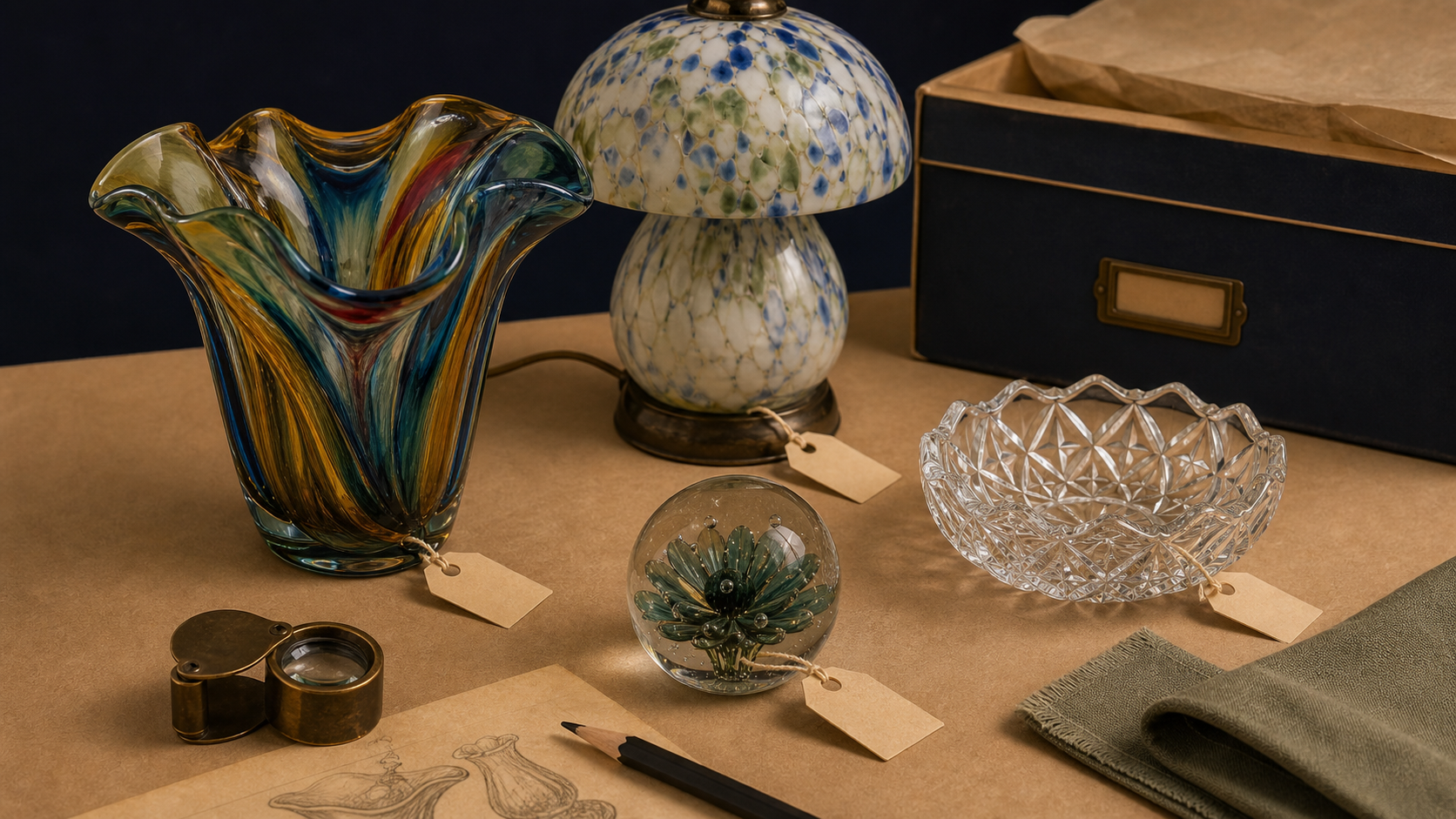
Understand why similar pieces can be worth very different amounts
One art glass vase can look like another on social media, but collectors pay for evidence. The spread often comes from three layers of proof: authenticity confidence, visual integrity, and scarcity inside a comparable style cluster. If any layer is weak, the value drops fast even when the object is pretty.
If you are deciding whether to keep, sell, insure, or appraise an object, start with visible proof before numbers. The first signal is not the base price—you are asking whether the object can survive comparison. If it cannot, a precise dollar value has little meaning.
Flip it over: verify maker clues before you chase an estimate
Do these checks in the first five minutes, before asking for an estimate:
- Find the maker signal. Collectors prefer clear, stable marks, model signatures, or catalog tags that align with known production patterns. If a mark is faint, compare magnified photos under raking light before trusting it.
- Read the base and construction. Bottom feet, seams, pontil impressions, and edge finishing reveal whether a piece was factory finished or heavily restored. Abrupt grinding lines or recent repainting can flatten value in a heartbeat.
- Check material coherence. True art glass, decorative glass, and decorative metal-backed or mixed-material pieces can look similar. Buyers pay differently when material claims do not match internal structure and weight.
- Match style claims to date evidence. A “vintage” description with modern decorative cues is common in listings. One honest line about mismatch risk is better than a speculative headline.
Read condition the way collectors read bidding risk
Collectors rarely buy blind. They price from visible damage history, not from idealized photos.
- Chips and repairs: Corner chips, re-fused joins, and obvious replacement parts lower confidence before they lower resale range.
- Finish wear: Uneven frosting, shell-like clouding, or heavy surface matte where the object is expected to remain polished can indicate heavy handling and lower top-tier resale.
- Lid, base, and frame fit: For composite objects with display hardware or matched sets, missing or mismatched support parts can remove a buyer’s “show it complete” premium.
- Evidence documentation: Multiple photos under natural light, side light, and close macro are critical. A single front shot is never enough for transparent pricing.
Don’t over-penalize minor age marks by default. A cleanly aged object with stable history can still be a strong market candidate. The critical distinction is between historical wear and active restoration, especially when buyers compare your item with sold comps.
Use this checklist on your first read
A typical listing path looks like this: you inherited a small LCT-style tile piece, and the seller’s story is short. On day one, compare the piece against photos of clearly attributed lots, then test whether the maker marks and glass behavior match the claimed era before pricing.
- List all visible identity clues (stamps, signatures, molds, base treatment).
- Separate honest age wear from modern restoration signs.
- Find three recent comps with the closest style, completeness, and condition profile.
- Start with the shared range, then reduce by 10–25% for uncertainty until photos and provenance are stronger.
If the item does not clear this first pass, pause on price and improve your documentation first.
Use real comps to turn your first estimate into a realistic range
Internal evidence for this topic is available, but small and uneven. Treat it as directional guidance rather than a guarantee. Internal auction records include examples such as:
- Loetz Papillon iridescent art glass vase — Bradford's — US$400
- 19th C LCT Tiffany Studio art-glass tile parts (167-piece lot) — Gold Coast Auctions — US$350
- 14K white-gold and diamond amphor glass starburst pendant in an art deco style lot — Gold Coast Auctions — US$400
What these examples mean in practice:
- A single lot marker can mix categories inside one sale, so lot price is only a starting bracket.
- Pieces with clearer maker context and steadier condition tend to hold premium windows even when the material is close.
- Missing accessories and incomplete sets usually move from top-tier to mid-tier faster than ordinary surface wear.
Use these points to set a floor and ceiling before writing your own listing price.
Note: We couldn’t find relevant auction comps in our database for this topic right now. If you’re valuing a specific item, try searching by maker/model/material and we’ll expand coverage over time.
What similar items actually sold for
To help ground this guide in real market activity, here are recent example auction comps from Appraisily’s internal database. These are educational comparables (not a guarantee of price for your specific item).
| Image | Description | Auction house | Date | Lot | Reported price realized |
|---|---|---|---|---|---|
| No relevant auction comps found for this topic right now. | |||||
Disclosure: prices are shown as reported by auction houses and are provided for appraisal context. Learn more in our editorial policy.
Free instant estimate
Not sure if your art glass is worth a full appraisal? Let us take a look.
Upload a photo, tell us the key details, and get a free first read. If it is worth a full appraisal, we will say so.
Free. No card needed. Takes about two minutes.
Turn clues into your own price range
Use this collector-style ladder:
- Base range: Start from the closest recent comps that share maker, type, and condition tier.
- Risk adjustment: Subtract for uncertain marks, structural wear, missing parts, and documented repairs.
- Premium adjustment: Add only for strong attribution, intact form, strong glaze and finish, and verifiable provenance.
If your object lacks provenance and has mixed cues, keep the range narrower than you think. It is safer to present as a broad bracket for private sale decisions, and ask for a written specialist review before anchoring a high fixed ask.
Common mistakes that usually cost collectors value
When this topic is covered quickly by sellers, the same three errors happen:
- Attributing every decorative piece to a famous studio without mark-level verification.
- Letting one polished photo define condition and hiding edge, base, and join views.
- Pricing from one sold lot only, even when your piece has a different completeness profile.
Collector trust starts with specificity. If you can answer what is original, what is altered, and what is missing, your range becomes easier to defend and easier to convert.
Think your art glass might be worth more than a baseline listing?
Upload photos and details for a free estimate before investing in broader marketing.
If the details strongly justify it, we will guide you toward a formal written appraisal next.
Search variations readers ask
Art-glass value variations
- How much is my art glass vase worth?
- What does a Tiffany art glass mark mean?
- How to tell if an art glass piece is real or restored?
- Why did similar art glass tiles sell for different prices?
- What condition issues lower art glass prices the most?
- Do incomplete sets reduce art glass auction results?
- How to document an art glass item for a better estimate
- Can I use auction results to estimate my vintage art glass?
- What is a good first photos checklist for art glass?