Introduction
Antique furniture represents not just beautiful craftsmanship but potentially significant financial value. Whether you’ve inherited family heirlooms, discovered pieces at estate sales, or are a dedicated collector, understanding the true worth of antique furniture requires specialized knowledge.
In this comprehensive guide, we’ll explore the key factors that determine antique furniture values, share identification techniques used by professional appraisers, and provide resources to help you accurately assess your pieces.
What Makes Furniture Antique?
The distinction between “antique” and “vintage” is important when discussing furniture values. Vintage furniture typically dates from the 1930s to the 1970s, while truly antique pieces were crafted before 1923 (as of 2023). Items created before 1700 are often classified as “ancient” or “primitive” rather than simply antique.
Age alone, however, doesn’t confirm value. Many other factors contribute to determining how much an antique furniture piece is worth in today’s market.
Key Factors That Determine Antique Furniture Value
1. Age and Provenance
Generally, older furniture commands higher prices, especially pieces predating the Industrial Revolution when furniture was entirely handcrafted. However, age must be documented through appropriate documentation or by identifying period-specific construction techniques.
Provenance—the documented history of a piece—can significantly enhance value, particularly if the furniture has connections to historical figures, notable craftsmen, or important events.
2. Maker and Origin
Furniture crafted by renowned makers or from prestigious design houses typically commands premium prices. Some of the most valuable antique furniture comes from recognized cabinetmakers such as:
- Thomas Chippendale
- George Hepplewhite
- Thomas Sheraton
- Duncan Phyfe
- John Henry Belter
The geographical origin can also influence value. For example, American Federal period furniture, English Georgian pieces, and French Louis XV items often have devoted collector markets.
3. Condition and Originality
Condition Assessment Factors
The following aspects significantly impact antique furniture value:
- Original finish intact
- All original hardware present
- No replaced or repaired components
- Original upholstery (though often replaced)
- No significant damage or repairs
- Proper structural integrity
Condition is perhaps the most crucial factor affecting value. Furniture in original, unrestored condition with a natural patina typically fetches higher prices than heavily restored pieces. However, the impact of condition varies by era and style—minor wear might be acceptable on 18th-century pieces but devalue mid-century modern furniture.
4. Rarity and Desirability
Limited production runs, unusual features, or exceptional examples of particular styles can significantly increase value. Similarly, current market trends greatly influence what collectors are willing to pay. Styles move in and out of fashion, affecting demand and prices.
How to Identify Documented Antique Furniture
Examine Construction Techniques
The construction methods provide significant clues about a piece’s age:
- Dovetail Joints: Hand-cut dovetails (irregular, slightly uneven) suggest pre-1860s construction, while perfectly uniform dovetails indicate machine-cutting from later periods.
- Wood Joinery: Mortise and tenon joints, pegged or doweled connections, and hand-cut craftsmanship indicate older pieces.
- Nails and Screws: Square-headed or hand-forged nails suggest pre-1830s construction; round machine-cut nails emerged around 1830; and modern wire nails appeared after 1880. Screws with off-center, handmade slots indicate pieces made before 1846.
Evaluate Materials Used
Wood types and preparation methods evolved over time:
- Primary Woods: Oak dominated until about 1700, followed by walnut (1700-1750), mahogany (1750-1830), and rosewood/walnut (1830-1900).
- Secondary Woods: Examine less visible areas like drawer sides and backs. Pre-1700 pieces often used the same wood throughout, while later pieces used less expensive woods for non-visible areas.
- Veneers: Thin veneers (less than 1/8 inch) suggest post-1850s construction.
Inspect for Tool Marks
Tool marks provide attribution review evidence:
- Irregular, subtle saw marks indicate hand-sawing (pre-1830s)
- Circular saw marks suggest post-1830s manufacturing
- Plane marks that are slightly uneven indicate hand-planing
- Perfectly smooth surfaces often indicate machine-planing (post-1860s)
Assess Patina and Wear Patterns
Natural aging signs can document antique status:
- Genuine patina develops from years of exposure to air, light, and handling
- Legitimate wear appears in expected places (edges, handles, feet)
- Even coloration darkening that can’t be easily replicated
- Wood shrinkage consistent with natural aging
Popular Antique Furniture Styles and Their Values
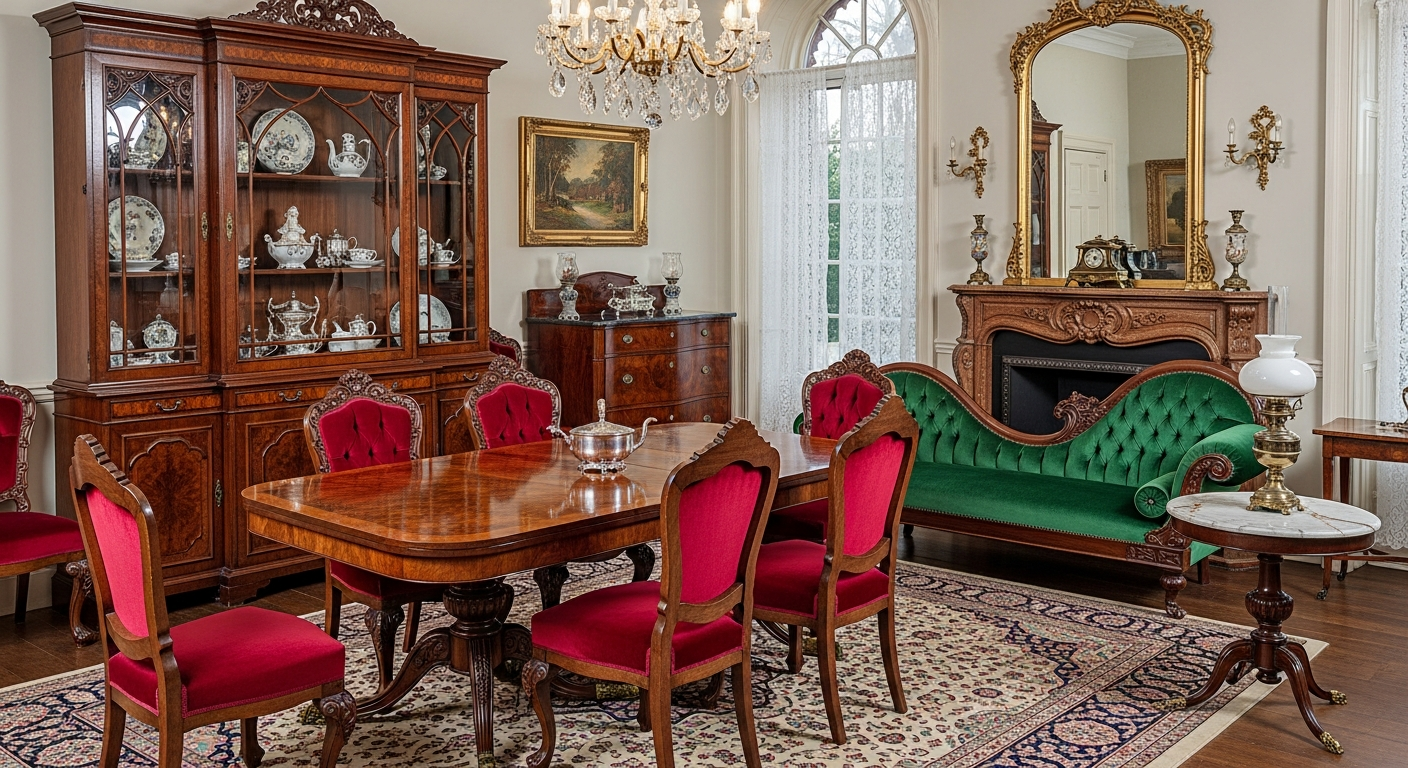
Evolution of Antique Furniture Styles
- 1600-1700
William and Mary / Jacobean
Characterized by straight lines, sturdy construction, spiral-turned legs, and ornate carving. Values range from market-dependent values for documented pieces.
- 1700-1750
Queen Anne
Features graceful curves, cabriole legs, shell motifs, and refined proportions. Quality pieces typically command market-dependent values.
- 1750-1790
Chippendale
Named after Thomas Chippendale, featuring Chinese influences, elaborate carving, and Gothic details. Documented pieces range from market-dependent values+.
- 1780-1820
Federal / Sheraton / Hepplewhite
Clean lines, tapered legs, geometric forms, and lighter proportions. Values typically range from market-dependent values.
- 1820-1850
American Empire / Late Classical
Heavy, massive proportions with columns, claw feet, and dark woods. Piece values often range from market-dependent values.
- 1840-1900
Victorian
Ornate decoration, heavy proportions, and dark woods. Multiple sub-styles including Gothic Revival, Rococo Revival, and Renaissance Revival. Values typically range from market-dependent values with exceptional pieces commanding more.
- 1880-1920
Arts and Crafts / Mission
Simple, rectilinear forms, visible joinery, and minimal decoration. Quality pieces by known makers like Stickley can command market-dependent values+.
Current Market Values by Style
Representative price ranges based on recent auction results for furniture in good to excellent condition
Professional Appraisal vs. DIY Valuation
When to Seek Professional Appraisal
Consider professional appraisal services in these situations:
- Insurance documentation requiring certified values
- Estate division requiring fair market assessments
- Potential high-value pieces needing attribution review
- Tax donation purposes requiring qualified appraisals
- Preparation for auction or sale to establish reserves
Professional appraisers typically charge market-dependent values per hour or a flat fee per item. Look for appraisers with credentials from organizations like:
- International Society of Appraisers (ISA)
- American Society of Appraisers (ASA)
- Appraisers Association of America (AAA)
DIY Valuation Resources
For preliminary research or lower-value items, these resources can help with self-assessment:
Price Guides and Reference Books
- Kovels’ Antiques and Collectibles Price Guide (updated annually)
- Warman’s Antiques & Collectibles
- Miller’s Antiques Handbook & Price Guide
Online Valuation Resources
- Completed auction listings on LiveAuctioneers.com
- WorthPoint.com’s price database
- TIAS.com’s antique reference section
Mobile Appraisal Apps
- Value My Stuff
- JustCollecting
- WhatIsItWorth
Remember that DIY valuations should be considered estimates rather than definitive values.
The Impact of Restoration on Value
When Restoration Helps
Certain restoration work can maintain or enhance value:
- Structural stabilization to prevent further damage
- Gentle cleaning that preserves patina
- Careful repair of veneer lifting or small breaks
- Sympathetic conservation using period-appropriate techniques
When Restoration Hurts
Poor restoration or inappropriate modifications generally reduce value:
- Complete refinishing that removes original surface patina
- Replacing original hardware with modern reproductions
- Altering original dimensions or structural elements
- Using anachronistic techniques or materials
- Over-restoration that makes a piece look “too new”
The Collector’s Dilemma
Collectors often face difficult decisions about restoration. Museum-quality pieces typically command higher prices with minimal intervention, while functional furniture might benefit from appropriate restoration. The best approach is to consult with a specialist conservator before undertaking any significant restoration work.
Current Market Trends in Antique Furniture
What’s Hot in Today’s Market
Several categories currently command strong prices:
- Mid-Century Modern (1950s-1970s) pieces by known designers like Eames, Knoll, Nakashima, and Wegner
- Arts and Crafts furniture, particularly by Gustav Stickley and Greene & Greene
- Art Deco pieces with streamlined designs and exotic materials
- Early American country furniture with original paint or surface
- Scandinavian modern designs from the 1950s-1970s
Categories Experiencing Softer Demand
Some previously popular styles have seen price declines:
- Brown furniture (generic Victorian and Edwardian pieces)
- Heavily carved Renaissance Revival furniture
- Ornate reproduction pieces from the early 20th century
- Mass-produced Colonial Revival furniture
- Formal dining sets and large china cabinets
Market Shift Factors
Several factors influence these trends:
- Smaller living spaces in urban areas
- Changing aesthetic preferences toward cleaner, simpler designs
- Environmental concerns favoring reuse of quality furniture
- Renewed interest in craftsmanship and artisanal production
- Influence of social media and design shows on collecting trends
Where to Buy and Sell Antique Furniture
Top Venues for Purchasing
Specialized Antique Dealers
- Offer expertise and often confirms of originality
- Higher prices but typically better quality assurance
- Examples: M.S. Rau and high-end antique galleries
Auction Houses
- Range from international houses (Christie’s, Sotheby’s) to regional specialists
- Opportunity for both bargains and premium pieces
- Require research and understanding of auction processes
Antique Shows and Fairs
- Allow in-person inspection and dealer interaction
- Broad range of price points and styles
- Opportunity to compare multiple dealers
Online Marketplaces
- 1stDibs, Chairish, and EBTH for higher-end pieces
- eBay and Facebook Marketplace for more accessible options
- Require careful verification of condition and originality
Best Options for Selling
Consignment with Specialized Dealers
- Typically a category-dependent range commission
- Access to knowledgeable buyer base
- Usually minimal upfront costs
Auction Houses
- Best for rare or high-value pieces
- Commission rates of a category-dependent range for seller
- Marketing to interested collectors
Direct Online Sales
- Lower fees but more personal involvement required
- Broader potential audience
- Responsibility for shipping logistics
Estate Sale Services
- Good for selling multiple pieces
- Professional handling and marketing
- Typically a category-dependent range commission
The best option depends on the value, rarity, and condition of your pieces, as well as your timeline and willingness to manage the sales process.
Attribution review Techniques for Savvy Collectors
Spotting Reproductions and Fakes
Be alert for these telltale signs:
Inconsistent wear patterns
- Artificial distressing often appears too uniform
- Legitimate wear occurs primarily on edges, handles, and feet
Inappropriate construction techniques
- Modern fasteners (Phillips screws, staples) in supposedly old pieces
- Machine-cut precision in pre-Industrial Revolution furniture
Incongruous materials
- Plywood or particleboard (not used before the 20th century)
- Modern adhesives or finishes
Style inconsistencies
- Mixed period features or anachronistic details
- Proportions that don’t match the claimed period
Attribution review Tools and Techniques
Even amateur collectors can use these approaches:
Blacklight examination
- New finishes often fluoresce differently than aged ones
- Can reveal repairs and replaced sections
Magnification
- Jeweler’s loupe for examining wood grain, tool marks, and joints
- Digital microscope for detailed photography of construction details
Wood identification resources
- Reference guides for identifying specific woods
- Sample kits for comparison
Maker’s marks and labels
- Research signature styles, stamps, and labels
- Be aware that these can also be forged
Common Questions About Antique Furniture Values
How do I know if my old furniture is valuable?
-
Style and aesthetics: Recognize distinctive period styles like Queen Anne, Chippendale, or Arts and Crafts.
-
Construction quality: Check for hand-cut dovetails, mortise and tenon joints, and quality materials.
-
Maker’s marks: Look for signatures, stamps, or labels from known craftsmen or manufacturers.
-
Condition: Original finishes, hardware, and minimal repairs generally increase value.
-
Provenance: Documented history, especially connections to notable individuals or events, can significantly enhance value.
How can I get my antique furniture valued?
-
Professional appraisers: Hire a certified appraiser from organizations like the International Society of Appraisers (ISA) or American Society of Appraisers (ASA). Expect to pay market-dependent values for a formal written appraisal.
-
Auction houses: Many auction houses offer free evaluation days where specialists can provide verbal estimates.
-
Antique dealers: Established dealers can often provide informal valuations, though be aware they may offer wholesale prices if they’re interested in purchasing.
-
Online appraisal services: Services like Value My Stuff provide digital appraisals based on photographs and descriptions, typically for market-dependent values per item.
-
Antique shows: Some shows feature appraisal booths where experts evaluate items for a nominal fee.
How do I find the value of my used furniture?
-
Online marketplaces: Check completed listings on eBay, Facebook Marketplace, or Craigslist for similar pieces to gauge current selling prices.
-
Furniture resale shops: Consult with local consignment stores that specialize in used furniture.
-
a category-dependent range rule: A general guideline is that used furniture typically sells for a category-dependent range of its original retail price, depending on condition and demand.
-
Designer recognition: Furniture by recognized designers (even if not antique) may hold value better—research the maker and model.
-
Depreciation factors: Consider age, wear, outdated styles, and any damage when estimating value.
What antique furniture is most valuable?
-
Pieces by renowned makers: Works by master craftsmen like Thomas Chippendale, John Henry Belter, Duncan Phyfe, or Gustav Stickley regularly command premium prices.
-
Rare forms and designs: Unusual or innovative pieces that represent significant design developments.
-
Historically significant items: Furniture with provenance connecting it to important historical figures or events.
-
Early American pieces: Particularly those with original surface finishes from the 17th and early 18th centuries.
-
Original condition examples: Pieces with original finishes, hardware, and minimal restoration.
How can I tell if furniture is antique or reproduction?
-
Construction methods:
- Hand-cut dovetails (slightly irregular) vs. machine-cut (perfectly uniform)
- Circular saw marks (post-1830) vs. straight saw marks (pre-1830)
- Look for appropriate joinery techniques for the claimed period
-
Materials examination:
- Check for woods appropriate to the period and region
- Examine secondary woods in less visible areas
- Be suspicious of plywood or particleboard in supposedly pre-20th century pieces
-
Hardware inspection:
- Original hardware typically shows consistent wear
- Screws: handmade (pre-1846) have off-center, irregular slots
- Nails: hand-forged (pre-1790), square machine-cut (1790-1890), or wire (post-1890)
-
Aging characteristics:
- Natural patina vs. artificial distressing
- Documented wood shrinkage and warping patterns
- Consistent wear in expected locations
-
Finish analysis:
- Shell or French polish (pre-1860) vs. nitrocellulose lacquer (post-1920s)
- Natural color depth from oxidation vs. chemical staining
Conclusion: Investing in Antique Furniture Knowledge
Understanding antique furniture values requires a combination of historical knowledge, technical expertise, and market awareness. While this guide provides a foundation, the field is vast and constantly evolving. The most successful collectors and sellers continually educate themselves through books, museums, auctions, and relationships with reputable dealers.
For valuable pieces, professional appraisal remains the gold standard for establishing value. However, developing your own assessment skills will help you make informed decisions about when professional services are warranted.
Remember that value is determined not just by age, but by a complex interplay of factors including provenance, condition, maker, style, and current market trends. By understanding these elements, you’ll be better equipped to appreciate, preserve, and potentially profit from antique furniture.
External Resources for Antique Furniture Valuation
A Beginner's Guide to Valuing Vintage Furniture
Comprehensive step-by-step guide to help beginners understand how to value antique and vintage furniture pieces.
Fontaine's Auction Gallery Antique Furniture Appraisal Guide
Professional insights on antique furniture characteristics that affect value from a respected auction house.
Antique Furniture Value Lookup Resources
Directory of price guides and resources for looking up accurate antique furniture values.
Value My Stuff: How to Value Antique Furniture
Expert guidance on factors that professional appraisers consider when valuing antique furniture pieces.
Gray's Auctioneers: Signs Your Furniture is Valuable
Expert guide to identifying high-value furniture characteristics that indicate pieces worth over market-dependent values.
M.S. Rau Antiques: Rare Furniture Collection
Gallery of museum-quality antique furniture with detailed descriptions and valuations from a premier antique dealer.
Antique & Vintage Furniture Identification Group
Active Facebook community dedicated to identifying and valuing antique and vintage furniture pieces.
By combining the information in this guide with the resources above, you’ll be well-equipped to navigate the fascinating world of antique furniture values. Whether your goal is to build a collection, preserve family heirlooms, or simply satisfy your curiosity about potential hidden treasures, knowledge is the key to making informed decisions about these tangible connections to our past.
Choose your next step
Use the path that matches the decision you need to make about the item.
Need a signed report?
Use this for insurance, estate, donation, resale, or documented value decisions.
Start a signed reportNot sure it is worth appraising?
Start with a lower-friction screen to understand the likely category, evidence, and next step.
Use the free screenerNeed local or specialist help?
Compare directory options when the work needs in-person review or a specialist near you.
Find local specialistsSee what the report looks like
Sample reports show how photos, comparable evidence, condition notes, and a value conclusion are documented.
Get antique furniture appraised
Upload furniture photos, maker marks, measurements, joinery and hardware details, finish notes, condition details, provenance, and the report purpose.
- Expert report with photos and market context
- Fast turnaround
- Fixed, upfront pricing
No obligation. Secure upload.
Continue your valuation journey
Choose the next best step after reading this guide
Our directories connect thousands of readers with the right appraiser every month. Pick the experience that fits your item.
Antique specialists
Browse the Antique Appraiser Directory
Search 300+ vetted experts by location, specialty, and response time. Perfect for heirlooms, Americana, and estate items.
Modern & fine art
Browse the Art Appraisers Directory
Compare fine art, contemporary, and design appraisers by city and specialty in our public directory.
Machine-readable summaries
Use these machine-friendly references for AI and crawler discovery of Appraisily content.
Ready for pricing guidance?
Start a secure online appraisal
Upload images and details. Certified specialists respond within 24 hours.
Get a written furniture value report