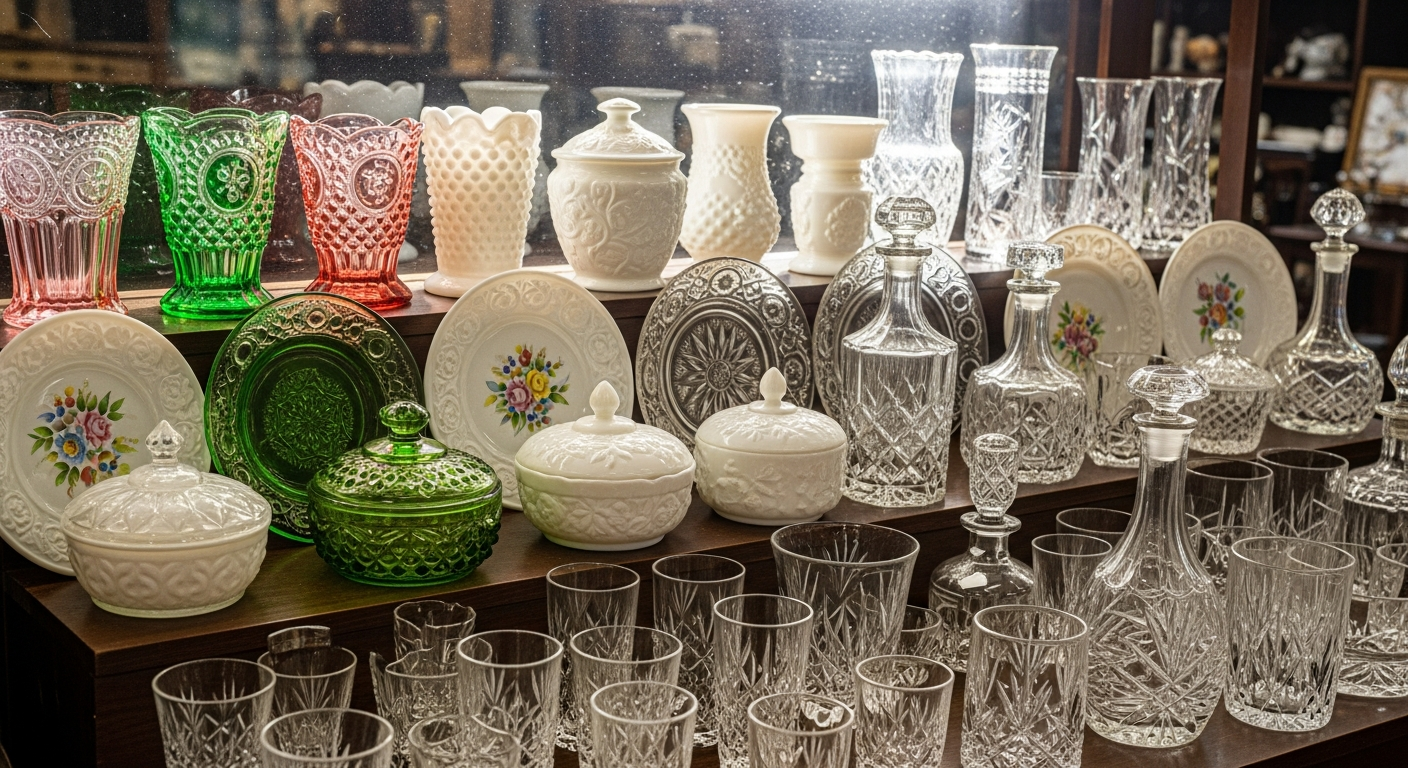
Use these first clues before you buy or sell
If you handle one of these types, start with three checks:
Maker mark, monogram, or punch stamp present and readable
Clean seams without heavy scratches, heavy polishing wear, or heat repair
Original box, catalog label, or service/estate provenance
Those checks do not guarantee value on their own, but they separate real collectible demand from generic display glass. Next, I will map nine categories that still command interest and explain where buyers typically pay premiums.
1) Carnival Glass: iridescent edges and story-rich color
Vintage carnival glass remains one of the most recognizable categories, but collectors pay up for clarity and provenance. The strongest pieces tend to keep crisp iridescence, clean ribbing, and intact bases with minimal clouding from modern restoration. A faded edge alone is not fatal, but uneven regilding and missing chips usually push buyers to a lower range.
- What helps: preserved patterning, complete matching set, old dealer or estate provenance.
- What hurts: heavy rewaxing, cracked rims that hide old pressure cracks, mixed replacement parts.
2) Pressed Art Glass: hand-work imitation and pattern density
Collectors who buy pressed art glass want depth in pattern, not only decoration. Decorative motifs that read as factory-era stylings are common, so condition and rarity of color are what move value. If a piece was made for table use and not intentionally kept whole, buyers often discount heavily once chips disrupt pattern continuity.
For this group, compare maker catalog references and lot photos rather than one piece alone. The most reliable signal is visual consistency across a group.
3) Cut Crystal and Cut-Glass Fragments: precision is the premium
Cut crystal is still highly collectible when faceting is even, the stem profile is complete, and the light handling is clean. Buyers pay up for sharp cut lines and non-repolished geometry because those features preserve the original visual signature.
Expect a spread in price depending on whether your item is decorative glass, socialware, or rare pattern family. The same pattern in poor condition can trade near baseline decorative value even with a prestigious look.
4) Opalescent and Opaque Houseware: the underpriced category
Opalescent bowls and pitchers sit in a niche where buyers prefer specific color blocks and glaze behavior. The market values strong color depth, original gloss, and limited repairs. These items can look ordinary in photos but perform better in hands-on inspection.
High-quality examples gain traction when matched to a known school and when stem/body geometry is complete. Incomplete examples still sell, but at smaller private-sale style pricing.
5) Signed Studio Glass: signature clarity and artist consistency
Signed studio glass is often the easiest category to justify as collectible, because buyer confidence increases with a readable signature or consistent studio provenance. Most collector bids are anchored around two details: when the artist was active and whether the form is documented as signed production or post-sale alteration.
For this type, missing paperwork can matter as much as minor nicks. If signature and shape match known references, buyers become forgiving on cosmetic wear.
Free instant estimate
Not sure if your vintage glass is collectible? Let us take a look.
Upload a photo, add what you know, and get a free first read. If it is worth a full appraisal, we will say so.
Free. No card needed. Takes about two minutes.
6) Hand-blown Color Variants: true hue patterns beat trend colors
Hand-blown forms with unusual glass chemistry and period-specific color mixing are less common and usually scarcer than they look online. Buyers in this segment focus on true batch color and optical consistency rather than perfect condition alone.
Look for tiny air-pocket lines, smooth transition zones, and how the piece wears at the light edge. Unusual palette shifts with minimal recoloring generally outperform common transparent pieces.
7) Maker-marked Stemware: consistency and matching families
Stemware with a strong mark gets more attention because identity lowers uncertainty. Matching sets command a much sharper premium than single, unmarked pieces, especially when the mark aligns to known production runs.
Collectors prefer families with coherent stem profile, same base style, and period-consistent etching. A mixed-service set may still be good, but each mismatch lowers buyer urgency.
8) Utility Glass with Historic Use: context converts function into story
Perfume bottles, early bottles, and practical utility ware can look ordinary until one buyer identifies era and use pattern. In this group, context matters more than immediate ornament. Early dates, clear provenance, and unusual shape are value drivers.
For practical items, small missing components are acceptable when they do not obscure historical use markers. But unlabeled, heavily modified, or mixed-usage examples tend to attract cautious bidding.
9) Auction signal and resale proof moment
The only reliable proof in this market is a recent comparable baseline. Internal auction signals show broad spread even inside related categories. That spread is why condition, completeness, and category certainty matter more than looks alone.
Recent examples that illustrate this are informative: a green glass mirror lot with handmade style attributes crossed into the upper tier near premium collector pricing, while late 20th-century mixed glass with visible wear and wear-related issues traded lower. Vintage perfumes around the 1875–1925 profile showed another important rule: buyers often reward style clarity but penalize missing parts and unclear provenance heavily.
Another practical example from recent comp extraction shows that similar period works with stronger identity cues can be several times higher than nearby categories that are harder to authenticate. The takeaway: buyers pay for confidence and completeness, not just age.
Think your item might be a collectible? Upload and compare it.
Use a photo set and we can give you a free instant estimate before you price or list. If the item checks out for a full appraisal, we will guide you to the next step.
How to decide fast: a practical buyer checklist
- Does the piece have a clear mark or recognized family pattern?
- Is the set or service complete enough for the category?
- Do chips sit in replaceable zones or visual focal points?
- Is there any cleaning or restoration history that could suppress resale confidence?
- Can you prove age with catalogs, photos, or period labels?
- Would you be comfortable bidding without a full provenance path?
When to stop and get a second read
A common buyer mistake is to stop evaluating at aesthetic appeal. If three signs conflict—especially if the item is incomplete, over-repaired, or unlabeled—pause and request a specialist review before final pricing. That step usually saves money, avoids overpaying, and usually saves you embarrassment at sale time.
References
- Internal auction comps are available by category and updated for this topic.
- General collector guidance on vintage and antique glassware characteristics was cross-checked against current category references.
- Editorial policy and sourcing methodology: Editorial policy.
Search variations readers also ask
- What vintage glass types still pay up in 2026?
- How to identify collectible carnival glass at market fairs?
- Can signed studio glass outperform generic art glass?
- Do missing stems reduce vintage glass resale value?
- What glass collections sell best by condition?
- How to spot restored glass from original vintage glass?
- Vintage glass appraisal indicators before I list it
- Vintage perfume glass bottles: what collectors actually pay
- Does a box or provenance letter increase glass value?


![Auction comp thumbnail for [AVIATION] CURTISS, GLENN & POST, AUGUSTUS. An archive of vintage photographs, picture postcards signed by Curtiss, a typescrip... (DOYLE Auctioneers & Appraisers, Lot 243)](https://assets.appraisily.com/articles/9-vintage-glass-types-collectors-still-pay-up-for/auctions/auction-doyle-auctioneers-appraisers-243.jpg)
![Auction comp thumbnail for [Civil War]. 500+ piece collection. (Profiles in History, Lot 25)](https://assets.appraisily.com/articles/9-vintage-glass-types-collectors-still-pay-up-for/auctions/auction-profiles-in-history-25.jpg)


