
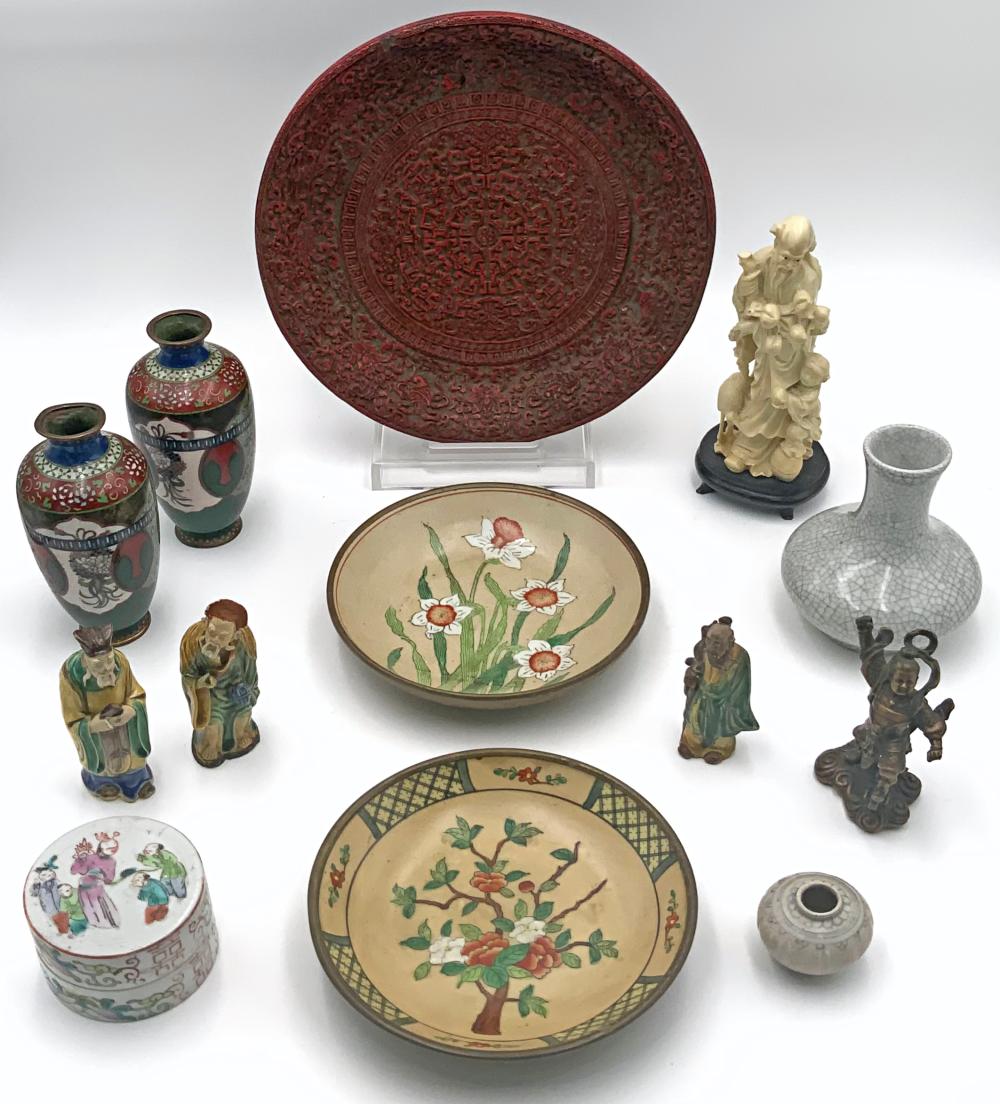
Export ware or a period piece?
This list is for someone holding a Chinese vase, a bronze censer, a jade carving, a cloisonne bowl, or a lacquer box and trying to decide whether it belongs on a decorative export shelf or in a period-evidence file.
Export production can be old. A Qianlong-period armorial plate is still export. A Republic famille rose vessel can wear the same birds-and-blossoms language as earlier wares. The expensive error is paying period-domestic prices for a later decorative finish that photographs well from the front.
The first filter is what the object will show in photographs:
- Whether a catalog is willing to say mark and period together, or only a reign name.
- Whether glaze, carving, or enamel wire varies where a hand would vary.
- Whether the foot was left alone or drilled, lamped, or remounted for display.
- Whether the paper trail is longer than one estate paragraph.
- Whether the listing names foot, join, and repair, or only rarity and investment.
The ten flags below are those checks. One flag is a pause, not a fake verdict. Sold amounts for named forms live in the comps table after the first two flags; they are not restated in the cards.
Read the mark as a lead, not a date
1) The markings are generic, translated, or too “modern” to be period
A mark can be present, readable, and still not date the body. Serious catalogs that mean both write mark and period in the same line. A Daoguang-marked famille rose gu catalogued that way is a different claim than a vase titled only “Qian Long.”
An archaistic Xuande seal on a bronze gui that the house still dates 18th/19th century is the same lesson in metal: the seal is there, and the object is later than Xuande. A Hongxian mark on a famille rose rouleau, or a Kangxi nian zhi mark sitting next to “style” language in a mixed porcelain-and-cinnabar lot, should not be treated as kiln proof.
Machine-clean, translated, or oddly symmetrical marks on a hand-finished surface are weaker still. Generic export marks are common on pieces made for decorative settings; they are a lead to photograph, not a date to pay.
Check first: Photograph the mark with the foot and the adjacent paste in one frame; if the listing will not say mark-and-period versus mark-only, stop treating the reign name as a date.
Check whether the glaze has a life story
2) The glaze and crackle pattern feels staged for display
Historic glaze usually records use: finer crazing in some zones, duller tone where hands held the piece, and color that does not migrate in a perfect sheet. When crackle depth looks the same at the rim, the belly, and the unhandled foot, the surface may still be old, or it may have been factory-aged for a decorative sale.
Auction titles almost never name staged crazing or a hot-fix glaze. The object family to compare is export porcelain itself: a Qianlong-period armorial plate, a nineteenth-century Rose Medallion charger and bowl, a Republic famille rose jardiniere. None of those lots is a sold “staged crackle” example; they are the glaze surfaces you should match against your photos.
A recent hot-fix that masks a chip often changes tool impressions around the edge. Ask for unfiltered raking-light shots before you treat even, pretty crackle as period wear.
Check first: Compare crackle at the rim, the belly, and the foot in one photo set; identical depth in high-wear and hidden zones is the staged-glaze question.
What similar items actually sold for
To help ground this guide in real market activity, here are recent example auction comps from Appraisily’s internal database. These matched sales are market context only, not an object estimate or identification, and they do not guarantee a price for your specific asian art object.
| Comparable | What sold | Auction house | Date | Lot | Source-reported amount |
|---|---|---|---|---|---|
| No auction photo supplied | A SMALL FAMILLE ROSE PALETTE ‘LOTUS POND’ PORCELAIN VASE China, Qing Dynasty, Yongzheng period Resting on a spread foot, with an elongated globular body and a trumpet neck. Adorned in famille rose enamels with a lotus pond. H: 18.6 cm ”莲池“瓷花瓶Source blocked; provenance matched | Adam's | 2021-11-23 | 77 | EUR 280 (buyer’s-premium treatment unknown) |
 |
Meiji Period Japanese Imari Pattern Porcelain 12" BowlSource blocked; provenance matched | Myers Fine Art | 2015-03-08 | 193 | USD 650 (buyer’s-premium treatment unknown) |
| No auction photo supplied | A Worcester Grainger period porcelain pot pourri vase and cover, campana shaped with swan handles, painted with two scenes of Worcester on a deep red ground, 36cm highSource blocked; provenance matched | Wellers Auctioneers | 2015-09-24 | 607 | GBP 260 (buyer’s-premium treatment unknown) |
| No auction photo supplied | Chinese Porcelain Yuhuchun Vase, Guangxu PeriodSource blocked; provenance matched | Ahlers & Ogletree Inc. | 2015-08-09 | 674 | USD 605 (buyer’s-premium treatment unknown) |
| No auction photo supplied | A Chinese Famille Rose Porcelain Tea Bowl, Republic PeriodSource blocked; provenance matched | Theodore Bruce Auctioneers & Valuers | 2026-02-23 | 8552 | AUD 300 (buyer’s-premium treatment unknown) |
How these auction records were verified
Each row retains its exact source URL, lot identity, retrieval time, access result, and immutable record hash. Live source access was blocked; the exact record matched Appraisily's immutable pipeline provenance. Inspect the public comparable provenance record.
Disclosure: prices are shown as reported by auction houses and are provided for appraisal context. Learn more in our editorial policy.
Mounts through listing copy: the rest of the flags
3) The mounting and display logic looks aftermarket
Mounts, pedestals, and lamp fittings can hide a drilled foot. Export-market objects were often made to be looked at; a later conversion still changes what you are buying. A Republic-period landscape vase made into a table lamp, and a Hongxian-marked famille rose rouleau drilled for lamping, are catalogued conversions, not guesses.
New screws, foam-lined inserts, and gallery-style hardware on an old-looking body need a repair or conversion note. A clean mount can be added for safety. Undocumented hardware is a different object than an untouched foot.
Check first: Turn the piece over for a drilled base, lamp rod, or modern insert before you accept a domestic-use story.
4) No meaningful maker context, yet claims of important attribution
“Attributed to,” “in the style of,” and “possibly period” are ordinary catalog hedges. They become a flag when the rest of the file is a dynasty word and a studio photo. A listing titled only “Qian Long Famille Rose Porcelain Vase” names a reign and a palette; it does not name a workshop, a kiln, or a condition note.
A Ming-dynasty gray jade mandarin duck is the other end of that spectrum: the catalog leans on material and form, not a slogan. “Private collection,” “museum grade,” and “legacy period” in the same paragraph, with no invoice or repair history, is copy covering a gap. Jade, bronze, and cloisonne Appraisily cards at this floor were not public-safe for this page; do not treat the porcelain pair above as a bronze or jade result.
Check first: Ask which workshop, kiln, or carver is named besides the dynasty word; if the file only has “attributed to” or “in the style of,” the attribution is copy, not a maker.
5) The material feel does not match era-appropriate tooling
Handwork leaves uneven groove depth, awkward tool transitions, and seams that do not repeat like a stamp. Decorative later work can look cleaner than the period it is quoting: regular undercuts, floral loops at identical scale, edges rounded for comfort rather than structure.
Sold-lot titles do not say “machine-regular tooling.” The closest object-form records are a Ming gray jade mandarin duck, a celadon-and-russet jade elephant dated late Ming to mid-Qing, and a nineteenth-century Japanese cloisonne bowl with a horse band. Those lots show carving and wirework as the evidence. They are not sold examples of factory-regular grooves.
Check first: Look at groove depth and enamel-wire line under raking light; perfectly repeated loops at scale are the tooling mismatch.
6) Provenance is mostly one paragraph and no trade ledger trail
A period claim that can be used in the trade usually has at least one hard edge: a prior invoice, a consignment note, a repair shop, dated photos, or an earlier auction footprint. A single “from an estate” sentence with no names or years is a decorative-market default, not a fraud proof.
Catalog titles almost never record a missing ledger. A round red cinnabar lacquer box is the named-form proxy in this pack: completeness and surface are what a serious lacquer sale is paying for, not a one-line story. Polished condition language with no named chip, crack, or loss is the same thin file in different words.
Check first: Ask for a prior invoice, consignment note, or dated photo; a single estate paragraph is not a ledger.
7) Price points jump oddly against size and detail level
List price is useful only against like objects. A large, average-finished decorative vase at a period-tier ask is the usual mismatch. Compare size, finishing, and what is actually documented before you treat the number as a date.
Named forms in this pack sit on a wide spread: a Daoguang mark-and-period famille rose gu, a nineteenth-century Rose Medallion charger and bowl, a part-gilt bronze luduan censer, and a short-titled Qian Long vase are not one market. Look at the comps table for the spread; this card does not repeat those hammer prices. For a weak file, a mid-range ask can still be fair. For a “premium period” claim, the ask has to point at a specific difference in mark, condition, or documentation.
Check first: Put height, finishing, and what is documented next to the comps table; if the ask only tracks size, it is not a period price.
8) Repair history exists, but repair provenance is missing
Repairs are not a disqualifier. Many period objects survive because someone filled a loss. The flag is a visible repair plus a confident period claim plus no timeline. New compound in a shadow, a fill that changes the silhouette, or a glue line that shifts the foot are the photos to request.
The only pack title that names the work is the Hongxian-marked famille rose rouleau: drilled for lamping, spider crack on the base, glue and paint residue on the foot rim. No other selected sale is titled as repair-without-report. Do not invent a second repaired lot. If the seller cannot say when the work was done, price the object as repaired decorative ware first.
Check first: Photograph fills, glue, and silhouette changes; if the seller cannot date the repair, do not price the object as unrepaired period ware.
9) The lot combines “good enough” period clues with obvious decorative-era shortcuts
Plenty of honest listings borrow historical motifs and still call the object later ware. The risk is treating a strong front as a complete proof stack. Republic-period famille rose vessels with birds and blossoms use earlier decorative language on a later body. A mixed lot that places a Kangxi nian zhi vase and a Qianlong-marked plate next to a cinnabar-style dragon charger is the catalog admitting “style” in the same breath as a reign mark.
If the photos are all signature features and none of the reverse, foot, or join, the file is incomplete. Beauty and rarity copy does not replace those views. This flag does not make your object decorative by default. It does block “undisputed period” until the hidden surfaces are in the file.
Check first: Demand reverse, foot, and join photos; beauty shots of the front are not a complete period file.
10) Seller language emphasizes investment narrative over object-level evidence
When the listing says “highly collectible period piece” and “rare surviving legacy item” but cannot name the foot, the join, the mark type, or a repair, the copy is doing the work the object is not. Romantic language is fine when it sits next to technical nouns. Adjectives alone are a sales signal.
No selected sale is titled as an investment pitch. The decorative-market proxies are a Japanese Satsuma lidded urn under a short object heading, and the thin “Qian Long Famille Rose Porcelain Vase” title already used as an attribution warning. Those lots sold as named ceramics, not as a story about future returns.
Check first: Strike “highly collectible” and “investment” from the listing and see what technical nouns remain; if none remain, the copy is the red flag.
Typical listing scenario
A typical online listing looks like this: a floral vase is called “possibly late Qing,” priced like a period object, and shown in one flattering studio shot. There is no reverse, no foot, and no repair note. The first signal is not “fake.” The signal is a verification gap.
If mark, glaze, foot, and paper trail still line up after you ask, the object can stay in play. If two flags hit, pause before you match a period ask.
People also ask about export ware vs period pieces
Can Chinese export porcelain still be period-dated?
Yes. Export ware can be eighteenth-century and still made for overseas buyers. A Qianlong-period armorial plate is period export, not a later fake, and it should not be priced as if it were a domestic court object.
Does a Qianlong or Xuande mark prove the piece is from that reign?
No. The mark is a lead. Catalogs that mean both the mark and the date say mark and period together. An archaistic Xuande seal on a later bronze, or Rose Medallion vases marked Qianlong in the early twentieth century, are why the body and the foot still have to agree.
Does converting a vase into a lamp ruin the object?
It changes the object. A drilled foot and lamp hardware are later work even when the body is Republic or older. Ask for the base photos; price the conversion, not an untouched vase.
Can decorative export ware still be worth appraising?
Yes. Named patterns, complete pairs, strong finishing, and honest condition still move. The appraisal question is which market the object actually sits in, not whether it is worthless.
Does one red flag mean the object is not period?
No. One flag means the proof stack is incomplete. Two or more flags, especially a thin mark plus a later mount plus no paper trail, is when you stop matching a period-tier ask.
References
- Object-form teaching in the cards uses public catalog types from the evidence pack: Chinese export and famille rose porcelain, bronze censers, jade carvings, Japanese cloisonne, cinnabar lacquer, and Satsuma. Sold amounts appear only in the injected comps table.
- One public-safe Appraisily example: matched pair of tall Rose Medallion porcelain vases marked Qing Dynasty and Qianlong.
- Appraisily editorial policy and sourcing standards: /editorial-policy/.